




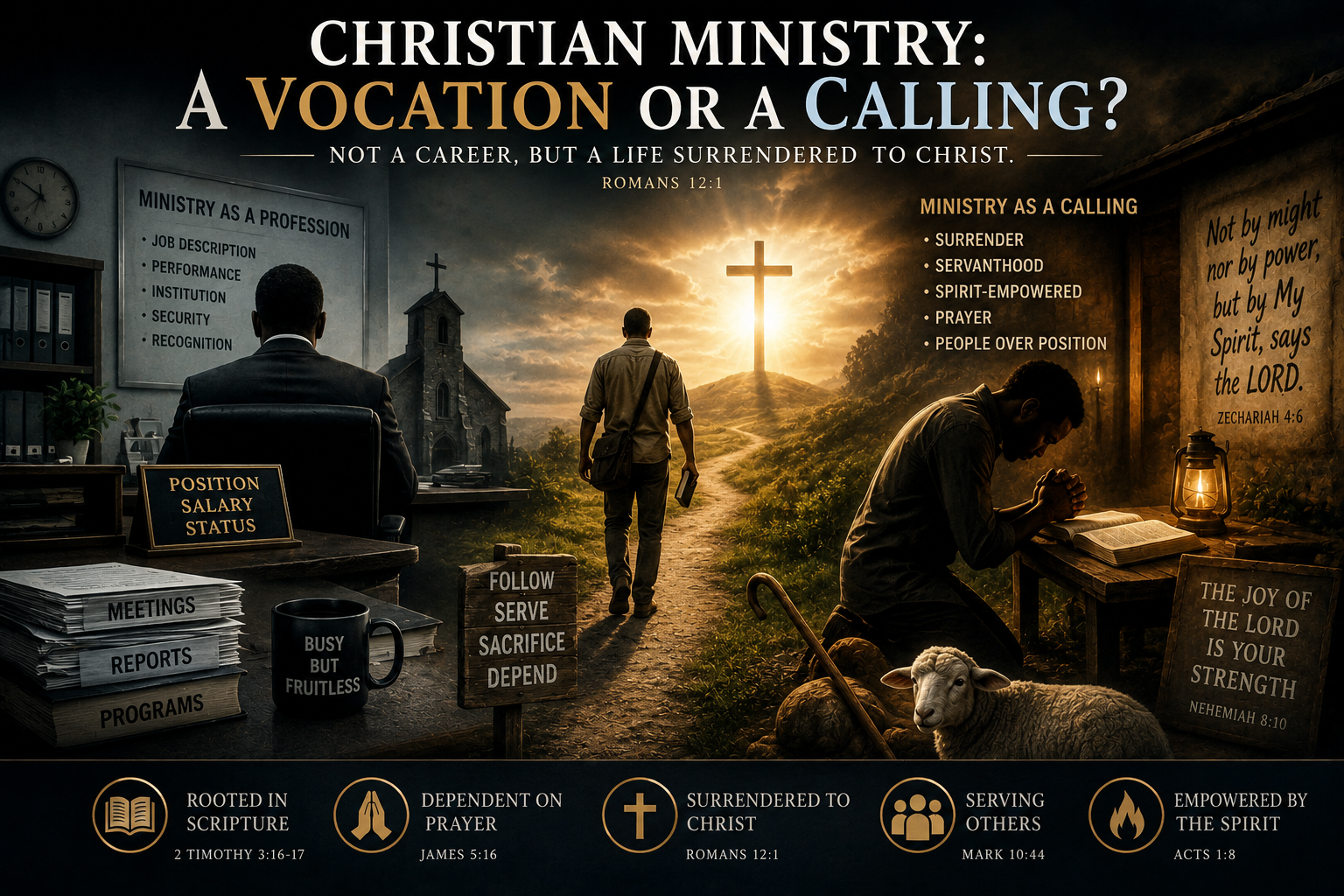
The question of whether Christian ministry is primarily a profession or a divine calling remains one of the most important issues facing the modern Church.
The New Testament presents ministry not as a career path, but as a life marked by:
- servanthood,
- sacrifice,
- suffering,
- prayer,
- and dependence upon the Holy Spirit.
Yet contemporary ministry increasingly reflects the logic of professionalisation:
- institutional management,
- measurable performance,
- financial dependence,
- and organisational efficiency.
This article argues that when ministry becomes reduced to professional vocation alone, the Church risks losing the spiritual authority and transformative power that characterised apostolic Christianity.
The Apostolic Paradigm
The ministry of the apostles was fundamentally sacrificial.
Paul describes himself not as a religious executive, but as:
“a slave of Christ.”
This language reveals total surrender and allegiance to Christ’s mission.
The article highlights that apostolic ministry was:
- relational,
- Spirit-dependent,
- and transformative rather than institutional.
Paul’s tentmaking ministry in Acts 18 further demonstrates his desire to preserve the integrity and prophetic freedom of the Gospel message.
Rather than relying entirely upon institutional structures, apostolic ministry often embraced:
- sacrifice,
- simplicity,
- and dependence upon God’s provision.
The result was ministry marked by spiritual potency rather than institutional security.
The Professionalisation of Ministry
The article strongly critiques the growing professionalisation of clergy within modern Christianity.
Many ministers now function primarily as:
- administrators,
- programme managers,
- organisational leaders,
- and institutional employees.
While structure and financial stability may provide practical benefits, the article argues that professionalisation also introduces serious spiritual dangers.
A Form of Godliness Without Power
One of the paper’s central concerns is the rise of what Paul describes as:
“a form of godliness but denying its power.”
The article argues that many modern ministers faithfully perform external religious duties:
- preaching sermons,
- conducting services,
- managing church systems,
- and organising programmes,
while lacking the spiritual vitality necessary for genuine transformation.
Andrew Murray and Richard Foster are both cited as warning against superficial ministry disconnected from:
- prayer,
- holiness,
- spiritual discipline,
- and dependence upon the Holy Spirit.
Without spiritual depth, ministry risks becoming:
- functional,
- mechanical,
- and spiritually powerless.
Institutionalism and Spiritual Apathy
The article also critiques the growing institutionalism within many churches.
Modern ministers often become preoccupied with:
- organisational efficiency,
- attendance figures,
- financial growth,
- and measurable outcomes.
The danger is that the Church begins mirroring secular corporate structures rather than embodying apostolic spiritual life.
When ministry becomes dominated by managerial logic, spiritual formation and encounter with God are gradually displaced.
The article argues that such dependence upon systems reflects a deeper loss of reliance upon the Holy Spirit.
Servanthood and Spiritual Authority
The New Testament consistently grounds Christian leadership in servanthood.
Jesus taught:
“Whoever wants to be first must be slave of all.”
Christian authority therefore emerges not through status or institutional power, but through:
- sacrifice,
- humility,
- obedience,
- and self-denial.
Paul describes himself as:
“being poured out like a drink offering.”
The article contrasts this apostolic model with modern transactional approaches to ministry where leadership may become shaped more by:
- contractual obligations,
- career expectations,
- and professional advancement
than by surrender to God’s calling.
Clerical Burnout
Professionalised ministry also contributes significantly to pastoral burnout.
Many ministers become overwhelmed by:
- administration,
- constant performance pressure,
- institutional demands,
- and emotional exhaustion.
The article argues that many pastors have gradually exchanged:
- spiritual calling,
- for managerial responsibility,
- leaving them spiritually depleted.
The problem is not simply workload.
It is disconnection from the spiritual life that sustains authentic ministry.
The Absence of Effective Prayer
One of the article’s strongest critiques concerns the neglect of prayer within modern ministry.
Prayer is presented not as optional devotion, but as the source of spiritual authority and effectiveness.
Charles Spurgeon famously warned:
“A minister who does not pray is a minister who cannot preach.”
The article argues that without deep communion with God:
- sermons lose power,
- leadership loses discernment,
- and ministry becomes spiritually hollow.
Financial Dependence and Prophetic Silence
Another challenge explored is the financial dependence of clergy upon institutional systems.
The article warns that dependence upon organisational preservation may compromise prophetic courage.
When ministers fear:
- financial insecurity,
- institutional conflict,
- or congregational backlash,
they may become reluctant to proclaim difficult truths.
The result is what the article calls a “domesticated clergy” more concerned with maintaining systems than confronting sin prophetically.
Reclaiming the Apostolic Vision
The article concludes by calling the Church back to an apostolic understanding of ministry.
Authentic ministry must once again prioritise:
- prayer,
- dependence upon the Holy Spirit,
- sacrifice,
- spiritual authority,
- and servanthood.
The Church must resist reducing ministry to:
- management,
- professionalism,
- or institutional maintenance.
Instead, ministry must remain rooted in:
- divine calling,
- spiritual transformation,
- and total allegiance to Christ.
The article also encourages churches to support healthier ministry patterns through:
- prayer retreats,
- sabbaticals,
- spiritual formation,
- and bi-vocational models that preserve prophetic freedom.
Conclusion
Christian ministry is ultimately not merely a vocation.
It is a divine calling demanding:
- surrender,
- sacrifice,
- holiness,
- prayer,
- and spiritual authority.
The apostles modelled ministry deeply rooted in:
- God’s presence,
- Spirit-filled power,
- and unwavering devotion to Christ.
The article warns that modern professionalisation risks replacing this apostolic vision with institutional functionality and spiritual weakness.
The Church therefore faces an urgent choice:
Will ministry remain a calling shaped by the power of God —
or become merely another profession shaped by the logic of the modern world?
Author
Brendon Naicker is a theologian, author, and teacher whose work explores theology, discipleship, ministry, and the spiritual challenges facing the contemporary Church. His writing frequently engages questions surrounding leadership, spiritual authority, prayer, and the recovery of biblical ministry in modern Christianity.