


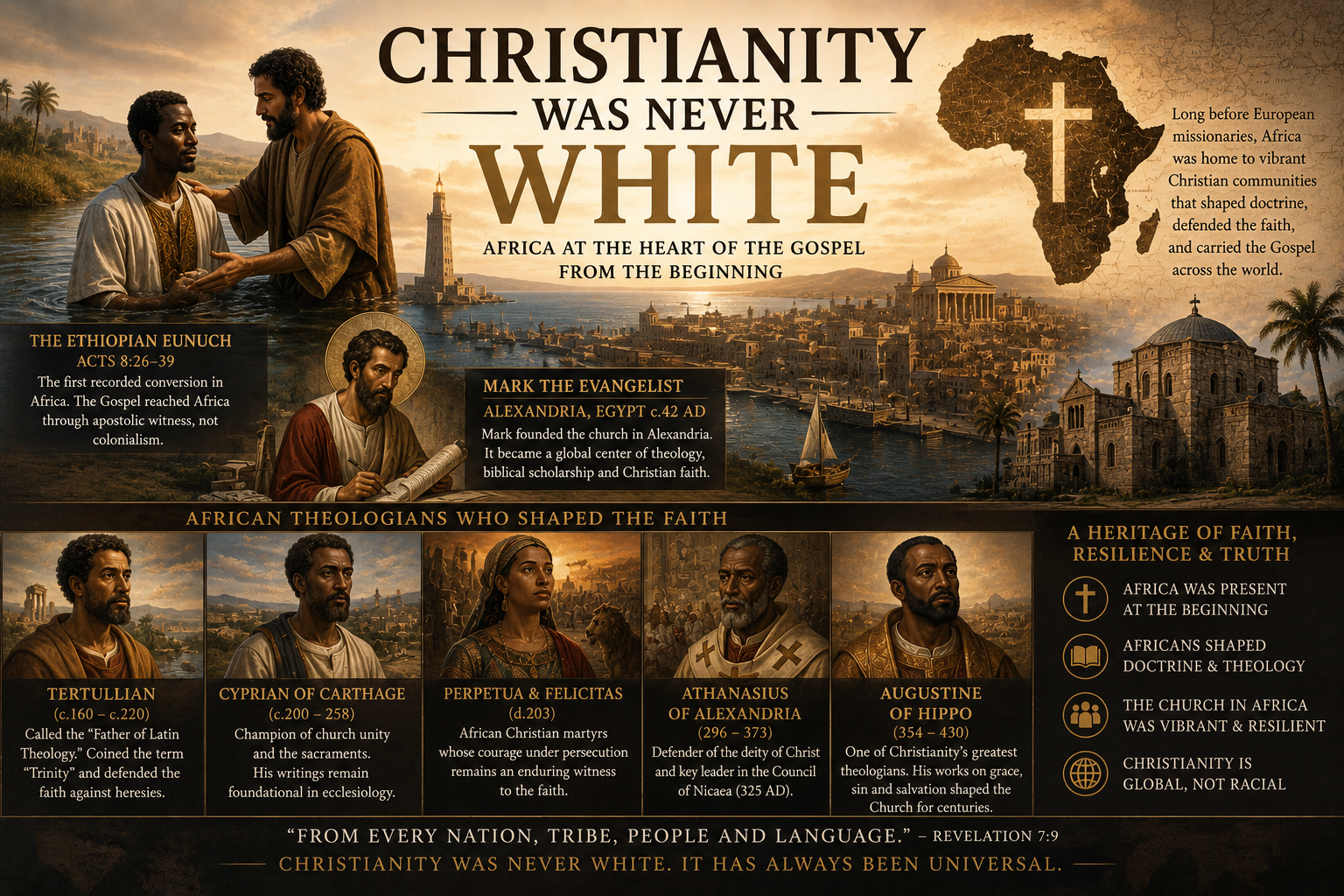
Christianity Was Never White
One of the most persistent misconceptions in modern culture is the idea that Christianity is fundamentally a “white man’s religion.”
This article directly challenges that narrative by demonstrating that Africa was present at the very origins of Christianity and played a foundational role in shaping the faith itself.
Far from being a late recipient of European missionary activity, Africa stood at the centre of early Christian history:
- apostolically,
- theologically,
- intellectually,
- and spiritually.
From the Ethiopian eunuch in Acts 8 to the theological influence of Alexandria and North Africa, Christianity has deep African roots stretching back to the earliest days of the Church.
The Ethiopian Eunuch: Africa’s First Recorded Convert
The article begins with one of the most significant biblical encounters in Christian history:
the conversion of the Ethiopian eunuch in Acts 8.
This high-ranking official from the court of Queen Candace encountered Philip on the road from Jerusalem to Gaza and was baptised after confessing faith in Christ.
This moment is profoundly important for several reasons.
Africa Was Present at Christianity’s Earliest Expansion
The Ethiopian eunuch represents the earliest documented instance of Christianity reaching the African continent.
This means Africa was not an afterthought in Christian history.
It was included from the beginning.
Christianity Entered Africa Apostolically
The Gospel did not first arrive in Africa through colonial expansion.
It arrived through direct apostolic witness.
According to the article, scholars such as Thomas Oden argue that the eunuch likely carried Christianity back to Ethiopia, helping establish one of the earliest African Christian communities.
Mark the Evangelist and the Church in Alexandria
The article next explores the tradition that Mark the Evangelist founded the church in Alexandria around AD 42.
Alexandria quickly became one of the most important centres of Christianity in the ancient world:
- intellectually,
- theologically,
- and spiritually.
Situated at the crossroads of Africa, the Mediterranean, and the Near East, Alexandria became a major hub for:
- biblical interpretation,
- theology,
- philosophy,
- and Christian leadership.
Theological Innovation from Africa
The article highlights the influence of:
- Clement of Alexandria,
- Origen,
- and the Catechetical School of Alexandria.
These African theologians profoundly shaped:
- biblical hermeneutics,
- Christology,
- Trinitarian theology,
- and Christian doctrine itself.
The Alexandrian tradition helped shape theological developments that later became foundational to global Christianity.
North Africa and the Formation of Christian Doctrine
Beyond Alexandria, North Africa became one of the great centres of early Christianity.
Cities such as Carthage produced some of the Church’s most influential theologians.
Tertullian
Tertullian, often called the “Father of Latin Theology,” coined the term Trinity and helped articulate Trinitarian doctrine in response to heresy.
Cyprian of Carthage
Cyprian developed foundational ideas concerning:
- church unity,
- ecclesiology,
- and baptism.
Perpetua and Felicitas
The article also highlights the witness of Perpetua and Felicitas, early African Christian martyrs whose courage under Roman persecution demonstrated the profound faith and resilience of African Christianity.
Athanasius and Augustine
African Christianity did not merely preserve the faith.
It defended and defined it.
Athanasius of Alexandria
Athanasius played a decisive role in defending the deity of Christ against Arianism during the fourth century.
His theological work became central to the formation of Nicene orthodoxy.
Augustine of Hippo
Augustine, one of Christianity’s most influential theologians, was also African.
His writings on:
- grace,
- salvation,
- sin,
- and the City of God
continue shaping Christian theology across Catholic, Protestant, and Orthodox traditions today.
The article therefore argues that African theologians were not peripheral figures in Christianity.
They stood at the very heart of its theological formation.
Reclaiming African Christian Heritage
A major theme throughout the article is the importance of reclaiming Africa’s Christian heritage in the modern world.
The misconception that Christianity is foreign to Africa often emerges from:
- colonial history,
- Eurocentric narratives,
- and ignorance of early church history.
Yet the evidence overwhelmingly demonstrates that:
- Africans shaped Christian doctrine,
- African churches defended orthodoxy,
- and African believers stood among the earliest followers of Christ.
The article argues that reclaiming this heritage is both:
- historically necessary,
- and theologically important.
It restores confidence, dignity, and continuity for African Christians today.
Christianity and African Identity
The article also addresses the relationship between African cultural identity and Christianity.
While contextualisation and African cultural expression are valuable, the paper insists that Scripture must remain the Church’s final authority.
African Christianity should therefore embrace:
- its biblical foundations,
- its apostolic heritage,
- and its theological contribution to the global Church.
Christianity is not alien to Africa.
Africa helped shape Christianity itself.
Conclusion
The story of Christianity cannot be told honestly without Africa.
From:
- the Ethiopian eunuch,
- to Alexandria,
- to Carthage,
- to Athanasius,
- to Augustine,
Africa stood at the centre of Christian history and theological development.
The article concludes by calling Christians to rediscover this forgotten heritage and reject narratives that portray Christianity as culturally foreign to Africa.
Christianity was never white.
It has always been global, multicultural, apostolic, and deeply rooted within the African story itself.
Author Box
Brendon Naicker is a theologian, author, and teacher whose work explores theology, church history, discipleship, and the global dimensions of Christianity. His writing frequently engages questions surrounding African Christianity, biblical identity, historical theology, and the recovery of neglected Christian heritage.