





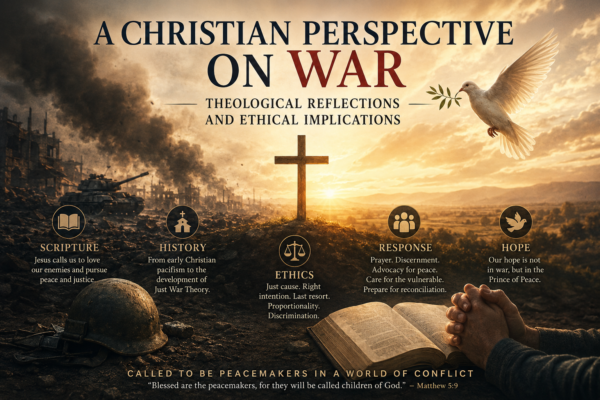
A Christian Perspective on War
War has always forced Christians to confront difficult moral and theological questions.
How can believers reconcile:
- Christ’s command to love enemies,
- with the obligation to pursue justice,
- defend the vulnerable,
- and restrain evil?
Throughout church history, Christians have responded in different ways:
- some embracing pacifism,
- others developing just war theory,
- while many continue wrestling with the ethical complexity of modern conflict.
This article explores the biblical foundations, historical developments, and ethical implications surrounding war, peace, and Christian responsibility.
Biblical Foundations of War and Peace
The Old Testament
The Old Testament presents a complex relationship between God, warfare, and justice.
God is sometimes portrayed as a warrior, as in Exodus 15:3:
“The LORD is a warrior; the LORD is his name.”
Yet the article stresses that such passages must be interpreted within their historical and theological context.
The conquest narratives, for example, are understood not primarily as endorsements of violence, but as testimonies to God’s sovereignty over history.
At the same time, the prophetic tradition consistently points toward peace.
Isaiah’s vision of swords being transformed into ploughshares anticipates a future where nations no longer learn war.
This eschatological hope forms an important foundation for Christian pacifism.
Jesus and the New Testament
The New Testament dramatically intensifies the emphasis on reconciliation, enemy-love, and nonviolence.
In the Sermon on the Mount, Jesus challenges the logic of retaliation:
“Do not resist an evil person.”
The article highlights theologian John Howard Yoder’s argument that Jesus calls His followers into a radically countercultural kingdom that rejects the violence of earthly powers.
At the same time, the New Testament does not entirely dismiss questions of justice or governance.
Paul acknowledges the state’s authority to restrain evil and maintain order (Romans 13:4), while still urging believers to:
“overcome evil with good.”
The tension between peace and justice therefore remains central to Christian ethics.
Pacifism in the Early Church
The earliest Christians were overwhelmingly pacifistic.
Many believers within the Roman Empire viewed military service as incompatible with discipleship to Christ.
Writers such as:
- Tertullian,
- and Origen,
argued that Christians were called to a different form of warfare:
- spiritual rather than military,
- prayerful rather than violent.
The early Church therefore understood itself as a countercultural community bearing witness to the peaceable kingdom of Christ.
The Rise of Just War Theory
The ethical landscape shifted dramatically after Constantine and the growing alliance between Church and state.
Augustine of Hippo developed what later became known as just war theory:
an attempt to reconcile Christian ethics with governmental responsibility.
Augustine argued that while war is always tragic, it may at times become morally necessary:
- to defend the innocent,
- restrain aggression,
- and restore peace.
Thomas Aquinas later systematised these ideas into a formal ethical framework that continues influencing both Christian and secular discussions of warfare today.
Just War Principles
Jus ad Bellum — Justice in Going to War
Christian just war theory establishes several criteria for determining whether entering war may be morally justified.
These include:
- just cause,
- legitimate authority,
- right intention,
- last resort,
- and probability of success.
War must never arise from:
- revenge,
- conquest,
- greed,
- or political ambition.
Its aim must be the restoration of justice and peace.
Jus in Bello — Justice During War
Even when war is considered justified, Christian ethics insists that conduct during war remains morally accountable.
Two core principles govern conduct:
Discrimination
Combatants must avoid targeting civilians.
Proportionality
The harm caused by military action must not exceed the good sought through the conflict.
These principles seek to restrain violence even within the tragedy of war itself.
How Should Christians Respond When War Is Imminent?
The article offers several practical and theological responses Christians should adopt during times of conflict.
Prayer and Discernment
Believers are called first to seek God through:
- prayer,
- Scripture,
- wisdom,
- and moral discernment.
Theological reflection requires humility in the face of complex moral ambiguity.
Advocacy for Peace
Christians should actively promote:
- reconciliation,
- diplomacy,
- dialogue,
- and peacebuilding wherever possible.
The Church’s prophetic role includes challenging the assumption that war is inevitable.
Care for the Vulnerable
War disproportionately harms:
- civilians,
- refugees,
- the poor,
- and the displaced.
The article emphasises that Christians should prioritise practical care and protection for those suffering under conflict.
Moral Discernment for Participation
For Christians involved in military service or political leadership, ethical reflection remains essential.
Participation in warfare must always be evaluated according to justice, restraint, and the minimisation of harm.
Preparing for Reconciliation
Even before conflict ends, Christians must prepare for:
- forgiveness,
- restoration,
- healing,
- and post-war reconciliation.
The goal of Christian ethics is never endless hostility, but restored peace.
Contemporary Challenges
Modern warfare raises new ethical dilemmas that complicate traditional just war frameworks.
Technologies such as:
- nuclear weapons,
- drones,
- cyber warfare,
- and long-distance targeting
increasingly blur the distinction between combatants and civilians.
The article therefore calls for renewed moral seriousness regarding violence and the sanctity of human life.
The Church’s Witness in a Violent World
The Church is ultimately called to embody Christ’s peace within a world marked by violence.
Historical peace traditions such as:
- the Quakers,
- Mennonites,
- and other peace churches
demonstrate that nonviolent witness remains a powerful Christian testimony.
Yet even within just war traditions, the ultimate Christian hope remains reconciliation rather than destruction.
Conclusion
Christian reflection on war remains deeply shaped by a tension:
the longing for peace alongside the responsibility to confront injustice.
Pacifism and just war theory each emerge from serious attempts to remain faithful to Scripture and the teachings of Christ.
In the face of conflict, Christians are called to:
- prayer,
- discernment,
- peace-making,
- protection of the vulnerable,
- and ethical responsibility.
Ultimately, the Church’s witness must point toward the peaceable kingdom of Christ:
a kingdom where justice and reconciliation are finally united.
Author
Brendon Naicker is a theologian, author, and teacher whose work explores Christian ethics, theology, discipleship, and the Church’s response to contemporary cultural and moral challenges. His writing frequently engages questions surrounding justice, peace, conflict, and Christian witness in the modern world.