
AI and the Beast
Revelation 13 presents one of the most unsettling visions in Scripture:
a beast that deceives the nations,
animates false images,
and compels allegiance through fabricated wonders and coercive power.
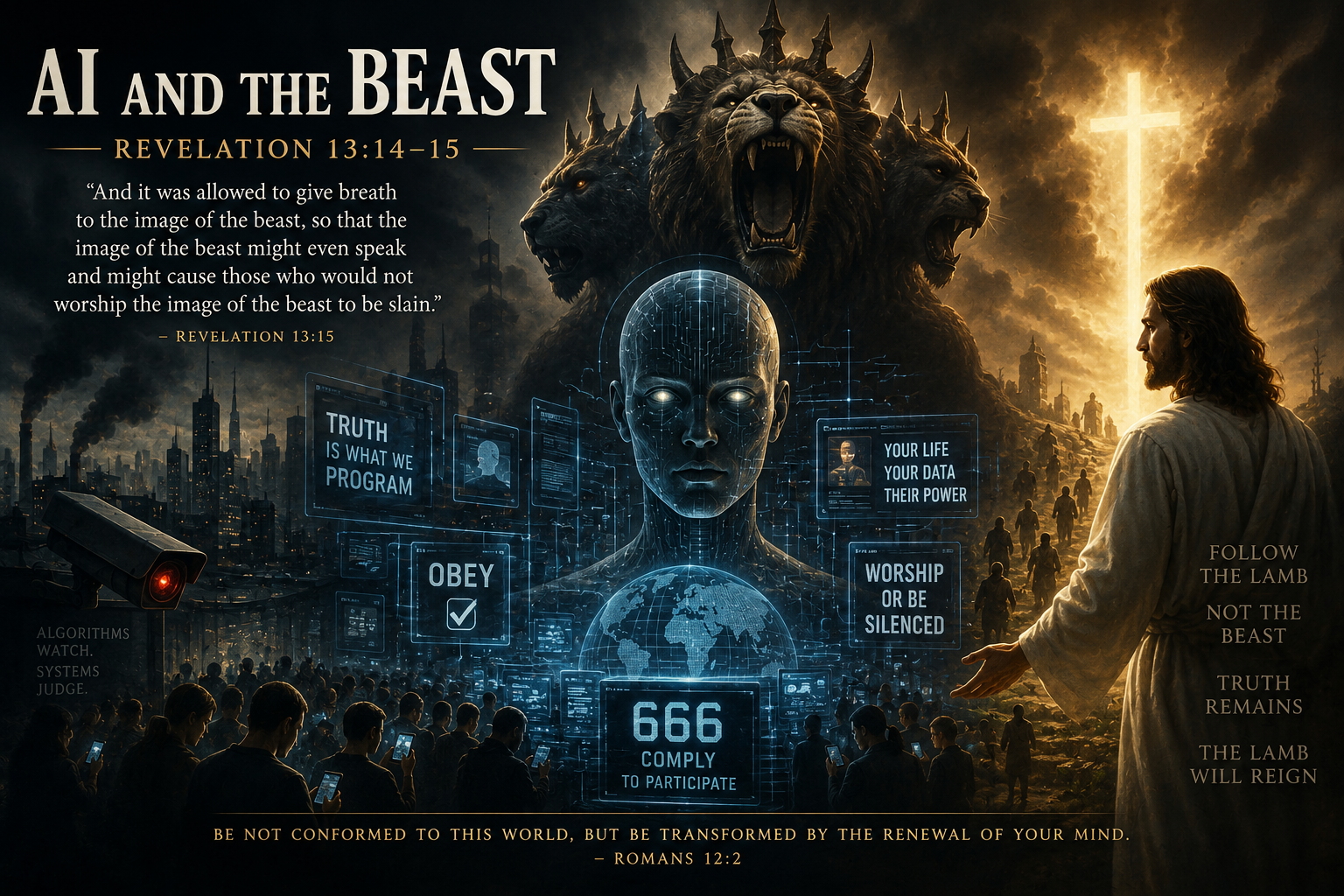
The passage describes an image of the beast that is given breath so that it appears to speak and demand worship.
Throughout history, Christians have interpreted Revelation’s imagery not merely as future prophecy, but as a recurring critique of idolatrous political, cultural, and spiritual powers.
This article argues that artificial intelligence increasingly reflects many of these “beastly” dynamics:
- simulated life,
- fabricated truth,
- deceptive signs,
- surveillance,
- and coercive systems of control.
The argument is not that AI is literally the beast of Revelation.
Rather, AI embodies patterns of deception and counterfeit authority that Revelation exposes and warns against.
Revelation 13 and the Counterfeit of Creation
The beast in Revelation functions as a counterfeit Christ.
It imitates:
- resurrection,
- authority,
- power,
- and life itself.
The beast’s apparent “healing” parodies Christ’s death and resurrection, while the image given “breath” imitates God’s act of giving life to Adam.
Yet the beast does not create reality.
It fabricates a distorted imitation of it.
This becomes one of the article’s central theological themes:
beastly power works through counterfeit creation and deceptive simulation.
Deception Through Signs and Wonders
Revelation emphasises that the beast deceives humanity through signs and wonders.
These signs appear persuasive precisely because they mimic truth while concealing falsehood.
The article argues that deception does not operate merely through obvious lies.
It often functions through simulations of truth:
fabrications that appear authentic while subtly distorting reality itself.
This insight becomes deeply relevant in the age of artificial intelligence.
The Speaking Image and Artificial Intelligence
One of the most striking parallels explored in the article concerns Revelation’s “image that speaks.”
Artificial intelligence increasingly produces:
- human-like speech,
- synthetic voices,
- deepfake videos,
- conversational avatars,
- and lifelike digital personas.
Generative AI systems now simulate:
- creativity,
- personality,
- emotion,
- and communication itself.
What Revelation described symbolically — an image appearing alive and speaking with authority — finds unsettling resonance within modern AI systems.
The article argues that AI does not truly create truth.
It recombines existing data into plausible simulations that often become indistinguishable from reality to users.
The boundary between truth and fabrication increasingly collapses.
Algorithmic Idolatry
The paper also explores how AI systems increasingly function with quasi-religious authority.
Algorithms are often presented as:
- objective,
- neutral,
- omniscient,
- and authoritative.
Yet many AI systems conceal:
- bias,
- distortion,
- manipulation,
- and structural injustice beneath a veneer of technical objectivity.
The article refers to this as a form of algorithmic idolatry:
the tendency to grant technological systems an authority that properly belongs to God alone.
AI increasingly fabricates not merely information,
but legitimacy itself.
Surveillance and Coercive Power
Revelation’s beast does not merely deceive.
It compels allegiance through coercion.
The article argues that modern surveillance systems increasingly mirror this dynamic.
Artificial intelligence now powers:
- predictive monitoring,
- behavioural manipulation,
- digital profiling,
- and algorithmic control systems.
Participation in modern society increasingly requires compliance with digital systems that:
- monitor behaviour,
- shape desires,
- influence beliefs,
- and regulate access.
The logic becomes:
participate or be excluded.
This reflects the same coercive structure Revelation associates with beastly power.
Deepfakes and the Collapse of Truth
Perhaps the most chilling aspect of modern AI is its ability to fabricate reality itself.
Deepfakes can:
- alter history,
- imitate voices,
- create false events,
- and generate entirely fabricated realities.
The article argues that this represents beastly deception at unprecedented scale:
not merely isolated lies, but the erosion of society’s ability to distinguish truth from falsehood altogether.
The information environment becomes saturated with simulations.
Truth itself becomes increasingly difficult to discern.
Theological Reflections: The Imago Dei and Counterfeit Humanity
The article frames AI theologically through the doctrine of the imago Dei.
Human dignity arises from being created in God’s image.
Yet AI systems increasingly reduce persons to:
- data profiles,
- behavioural predictions,
- algorithmic probabilities,
- and optimised resources.
This produces a distorted anthropology:
human beings cease to be image-bearers and instead become quantifiable units within technological systems.
The article argues that this dehumanisation mirrors the beastly pattern of counterfeit personhood:
simulations replacing genuine humanity itself.
Satan as the Father of Lies
Jesus describes Satan as:
“the father of lies.”
Theologically, beastly power operates by fabricating realities that obscure God’s truth.
The article therefore argues that AI becomes spiritually dangerous not because of machinery itself, but because it increasingly functions as a medium for deception:
eroding humanity’s ability to distinguish:
- truth from fabrication,
- reality from simulation,
- and authentic presence from synthetic imitation.
The Church’s Response
The article calls the Church toward discernment rather than panic.
Resist Technological Idolatry
Christians must resist the temptation to treat AI as:
- omniscient,
- salvific,
- or morally authoritative.
Technology must remain servant rather than object of trust.
Cultivate Attention and Discernment
The article strongly emphasises spiritual attentiveness.
Practices such as:
- prayer,
- Scripture,
- silence,
- and worship
train believers to recognise truth amidst digital deception.
Discernment becomes not merely intellectual, but spiritual formation.
Bear Witness to Truth
In a world increasingly shaped by fabricated signs, the Church’s calling is to embody truthful witness.
Christ is described in Revelation as:
“the faithful and true witness.”
The Church participates in that witness by:
- exposing deception,
- affirming truth,
- and refusing allegiance to counterfeit powers.
Hope in the Triumph of the Lamb
Despite its warnings, Revelation ultimately directs attention not to the beast, but to the Lamb.
The article closes with eschatological hope:
beastly systems are temporary,
but Christ’s truth endures eternally.
AI may intensify deception and confusion.
Yet Christians need not surrender to fear.
The Lamb has already triumphed.
Conclusion
Artificial intelligence increasingly reflects many of the dynamics Revelation associates with beastly power:
- deception,
- counterfeit creation,
- fabricated speech,
- surveillance,
- and coercive allegiance.
The theological challenge of AI lies not merely in technology itself,
but in its capacity to obscure truth, distort humanity, and redirect worship.
The Church is therefore called to:
- discernment,
- truthful witness,
- resistance to idolatry,
- and renewed allegiance to Christ alone.
Though fabricated realities may saturate the world,
truth ultimately belongs to the Lamb.
And the Lamb will reign long after every beastly system has fallen.
Author
Brendon Naicker is a theologian, author, and teacher whose work explores artificial intelligence, theology, digital culture, and Christian discipleship. His writing frequently examines the relationship between technology, idolatry, truth, and the spiritual challenges facing the Church in the modern age.