




African Christianity has become one of the most significant forces within global Christianity. Yet alongside remarkable growth come serious theological, cultural, and spiritual challenges that threaten the Church’s unity and faithfulness to Scripture.
This article explores several of these pressing concerns:
- theological dependence,
- denominational fragmentation,
- the prosperity gospel,
- socio-political compromise,
- and the ongoing identity crisis facing the African Church.
At its core, the article calls African Christianity back to:
- biblical authority,
- unity in Christ,
- and renewed commitment to the Gospel above cultural or ideological pressures.
Theological Dependence on the West
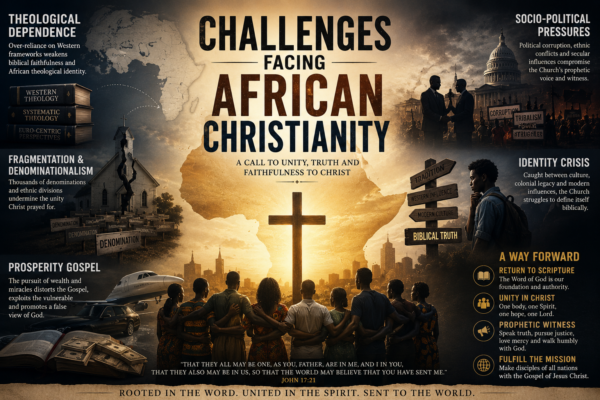
One of the article’s major concerns is the continued dependence of many African churches upon Western theological frameworks.
This dependence often creates:
- theological uncertainty,
- identity confusion,
- and difficulty articulating an authentically biblical voice within African contexts.
While theologians such as Kwame Bediako highlight the need for African Christianity to develop its own theological articulation, the article insists that true theological independence must ultimately remain rooted in Scripture rather than merely replacing one cultural framework with another.
The Gospel transcends all cultural systems.
Paul’s warning against factionalism and personality-driven allegiance in 1 Corinthians reminds the Church not to elevate any external narrative above biblical truth itself.
Fragmentation and Denominationalism
The article also critiques the intense fragmentation of African Christianity.
Across many African nations, the rapid multiplication of denominations and independent ministries has produced:
- doctrinal confusion,
- competition,
- personality cults,
- and weakened ecclesial unity.
Rather than embodying the biblical vision of one body in Christ, the Church often mirrors the ethnic, tribal, and political divisions of wider society.
The article specifically highlights how ethnic affiliations in countries such as Nigeria frequently shape denominational identities more than the unifying message of the Gospel.
Yet Scripture consistently calls the Church toward:
- unity in diversity,
- reconciliation,
- and shared identity in Christ.
The Prosperity Gospel
One of the strongest critiques within the article concerns the rise of the prosperity gospel across parts of Africa.
Prosperity theology often equates:
- material wealth,
- financial success,
- and physical well-being
with signs of divine favour.
The article argues that this distorts biblical teaching by transforming faith into a transactional mechanism for personal gain.
Rather than emphasising:
- contentment,
- stewardship,
- sacrifice,
- and trust in God,
prosperity teaching often reduces Christianity to:
- financial breakthrough,
- miracle promises,
- and seed-faith offerings.
The article warns that vulnerable believers are frequently exploited through financial pressure disguised as spiritual obligation.
This creates:
- disillusionment,
- inequality,
- and distorted expectations regarding God’s purposes.
Secularisation and Political Pressures
African Christianity also faces growing socio-political pressures.
The article notes that entanglement with:
- political power,
- corruption,
- ethnic conflict,
- and national agendas
often compromises the Church’s prophetic witness.
Rather than functioning as:
- salt and light,
- moral witness,
- and peacemakers,
churches sometimes become absorbed into worldly systems of influence and division.
The prophets of the Old Testament model a different calling:
speaking truth to power while remaining faithful to God’s righteousness and justice.
The article argues that the African Church must recover this prophetic courage.
The Identity Crisis of African Christianity
A deeper issue explored throughout the paper is the identity crisis within African Christianity itself.
Historically shaped by colonialism and missionary structures, African Christianity continues wrestling with questions of:
- contextualisation,
- cultural identity,
- and theological authenticity.
The article acknowledges the value of contextual theology and African cultural expression, but insists that contextualisation must remain subordinate to biblical authority.
Efforts to recover African identity must never eclipse:
- Scripture,
- the universality of the Gospel,
- or the unity of the Church in Christ.
Rediscovering Biblical Foundations
The article calls the African Church not primarily to rediscover cultural roots, but to rediscover biblical foundations.
Paul’s command to Timothy to:
“preach the Word”
is presented as central to the Church’s identity and mission.
The article also addresses concepts such as Ubuntu and African communal traditions.
While recognising their value, it argues that such cultural frameworks must always be evaluated in light of Scripture and the biblical vision of koinonia — Spirit-filled fellowship within the body of Christ.
Culture may illuminate aspects of human experience.
But Scripture remains the Church’s ultimate authority.
Global Influence and Local Faithfulness
African Christianity increasingly exerts global influence.
As Western Christianity declines in many regions, African churches are becoming major theological and missionary voices worldwide.
Yet the article warns that growth and influence alone are insufficient.
The Church must resist the temptation to become captive to:
- ideological agendas,
- cultural nationalism,
- political movements,
- or theological compromise.
The Church’s mission remains fundamentally:
- proclaiming the Gospel,
- discipling nations,
- and bearing witness to Christ.
Conclusion
Contemporary African Christianity stands at a critical moment.
Its rapid growth carries enormous potential for global Gospel witness.
Yet the Church also faces serious challenges:
- theological dependence,
- fragmentation,
- prosperity teaching,
- political compromise,
- and cultural confusion.
The article ultimately calls the African Church back to:
- Scripture,
- unity in the Spirit,
- prophetic courage,
- and identity in Christ above every cultural or denominational division.
Only through renewed faithfulness to God’s Word can the African Church fully embody its calling as a witness to the world.
Author
Brendon Naicker is a theologian, author, and teacher whose work explores theology, culture, discipleship, and the challenges facing the global Church. His writing frequently engages issues surrounding biblical authority, African Christianity, church unity, and faithful Christian witness in contemporary society.