



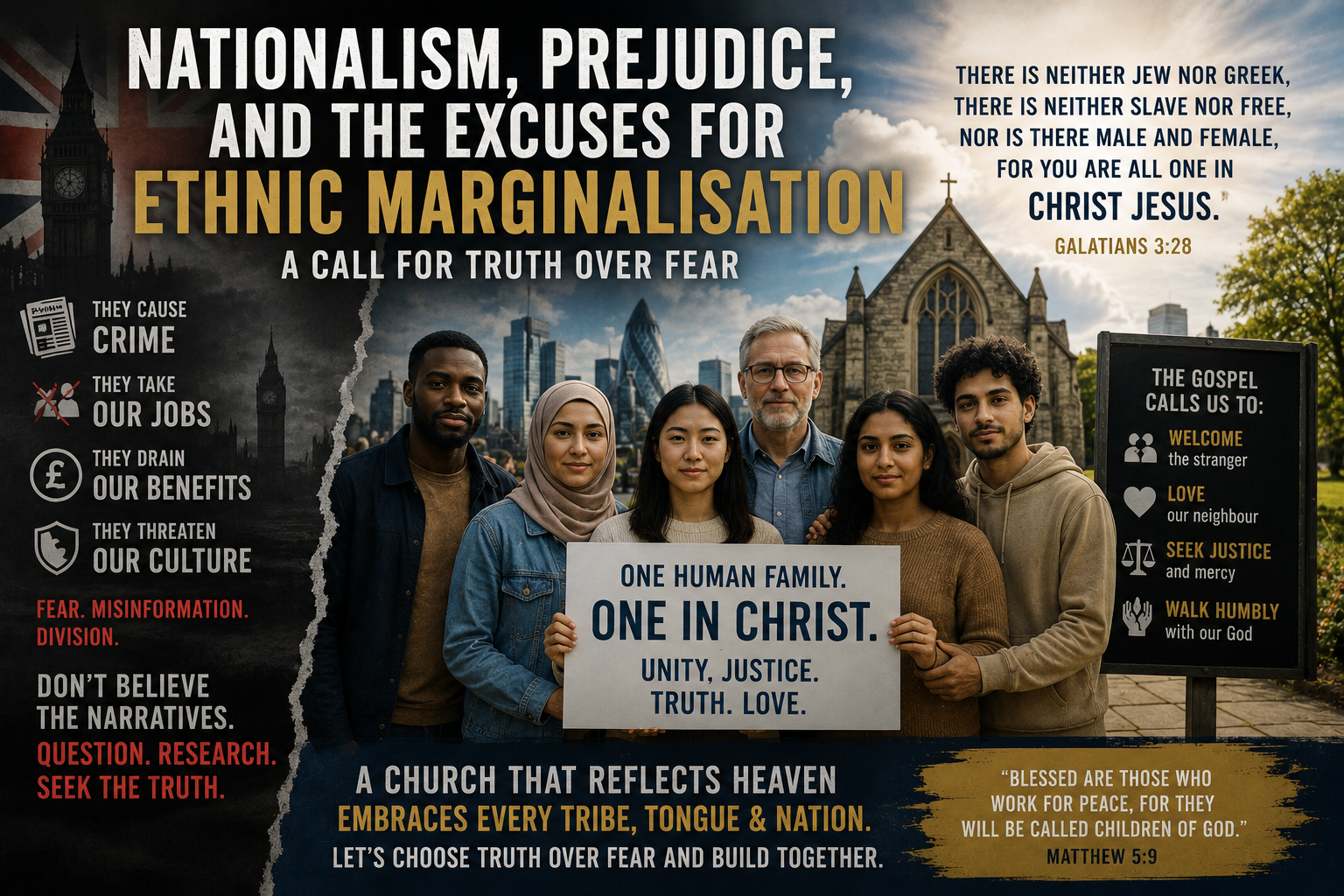
Introduction
Throughout history, societies facing uncertainty, economic hardship, or cultural change have often searched for groups to blame.
In recent years, ethnic minorities have increasingly been scapegoated for issues ranging from crime and job insecurity to the supposed erosion of national identity. These narratives frequently gain traction not only within political discourse but also within social and religious spaces.
This article explores the relationship between nationalism, prejudice, and ethnic marginalisation while examining how fear and misinformation can subtly influence both society and the Church.
The Scapegoating Pattern
History repeatedly demonstrates how fear can fuel exclusion.
During periods of instability, minority groups are often portrayed as threats responsible for:
- Economic decline
- Rising crime
- Social instability
- Cultural change
- National insecurity
Yet many of these claims collapse under careful scrutiny.
The article argues that such narratives frequently function as distractions from deeper systemic issues, while reinforcing subconscious bias and division.
The Crime Narrative
One of the most persistent claims within nationalist rhetoric is the idea that ethnic minorities disproportionately contribute to crime.
However, research demonstrates that minority communities are often:
- Over-policed
- Disproportionately stopped and searched
- Subjected to harsher sentencing outcomes
The Lammy Review revealed that Black individuals in the UK were significantly more likely to be stopped and searched than white individuals, reflecting broader institutional disparities rather than simple criminality statistics.
Additionally, research from the London School of Economics found no significant link between immigration and rising crime rates.
The “Taking Our Jobs” Myth
Economic anxiety is another area where minorities and immigrants are frequently blamed.
Yet economic research consistently demonstrates that immigrants often:
- Fill labour shortages
- Contribute to economic growth
- Support public services
- Increase entrepreneurship
- Contribute more in taxes than received in benefits
Rather than addressing structural economic issues such as automation, outsourcing, wage stagnation, or labour exploitation, populist narratives frequently redirect frustration toward vulnerable communities.
Nationalism and Exclusion
National identity can foster cultural pride and social cohesion when held responsibly.
However, nationalism becomes dangerous when it transforms into exclusionary ideology driven by fear and suspicion.
Across parts of Europe and the West, far-right nationalist movements increasingly frame ethnic diversity as a threat to “traditional values,” often influencing public discourse and even religious communities.
Christianity and Biblical Inclusion
The article contrasts nationalist exclusion with the biblical vision of unity and inclusion.
Scripture consistently emphasises:
- Hospitality
- Justice
- Equality
- Reconciliation
- Multi-ethnic unity in Christ
Galatians 3:28 declares:
“There is neither Jew nor Greek… for you are all one in Christ Jesus.”
Similarly, Revelation 7:9 presents a vision of believers from every tribe, tongue, and nation worshipping together before God.
This biblical vision stands in direct tension with racial exclusion or ethnocentric nationalism.
The Challenge of Institutional Silence
The article also raises concerns regarding the reluctance of some Christian institutions to engage openly with issues surrounding racial inclusivity and leadership diversity.
Without accountability and self-reflection, organisations risk becoming echo chambers that reinforce existing biases rather than confronting them honestly.
The issue is presented not merely as social or political, but theological.
Truth Over Fear
At its core, this discussion concerns truth, justice, and the moral responsibility to reject fear-driven narratives.
The article argues that misinformation and prejudice can only be challenged through:
- Honest dialogue
- Accountability
- Humility
- Compassion
- Commitment to justice
Christian communities are called to resist prejudice and embody the reconciling message of the Gospel rather than reflecting the fears and divisions of wider culture.
Conclusion
Nationalism, prejudice, and ethnic marginalisation remain deeply relevant issues within both society and the Church.
The excuses often used to justify exclusion — crime, economics, cultural fear, or national identity — frequently conceal deeper biases and systemic inequalities.
The Church is called not to mirror fear-driven cultural narratives but to embody the justice, truth, hospitality, and unity found in Christ.