
Values-Aligned AI in Christian Ministry
The emergence of “values-aligned” artificial intelligence marks a significant new chapter in the relationship between technology and the Church.
AI systems are now being customised according to theological and moral frameworks, enabling churches to experiment with tools designed to assist:
- sermon preparation,
- pastoral care,
- discipleship,
- communication,
- and ministry administration.
Projects such as Gloo AI openly seek to develop systems trained according to a congregation’s doctrinal commitments and pastoral goals.
The appeal is understandable.
Many ministers face:
- administrative overload,
- declining attention spans,
- digital distraction,
- and increasing pressure to maintain online engagement.
Yet beneath the practical enthusiasm lies a much deeper theological question:
Can a machine truly embody Christian values?
The Problem of “Alignment”
At the heart of values-aligned AI lies a particular assumption:
that moral reasoning and theological conviction can be codified into computational systems.
The article argues that this reflects a modern technocratic mindset in which morality is treated like information to be programmed rather than virtue to be cultivated.
Christian theology, however, understands moral life differently.
Christian ethics is not merely abstract reasoning.
It is participation:
- participation in God,
- participation in communion,
- participation in embodied relationships through the Holy Spirit.
This creates a profound theological tension.
When “Christian values” are detached from relational life and reduced to data-driven outputs, the Church risks a form of disincarnation — reducing embodied communion to informational correspondence.
The Imago Dei and Relational Life
Christian anthropology insists that humanity bears the imago Dei:
human beings are relational, embodied, attentive creatures called into communion with God and neighbour.
An algorithm may imitate moral language.
But it cannot participate in the relational depth from which true moral action arises.
As theologian John Zizioulas argues:
“Personhood is not an attribute of substance but an event of communion.”
The article therefore argues that AI in ministry must always remain subordinate to an ecclesial anthropology in which values are lived relationally rather than computationally.
The critical question is not:
“Can AI simulate Christian speech?”
But:
“Does its use deepen communion with God and neighbour?”
The Ethics of Attention
One of the article’s most important contributions is its focus on attention.
Attention has become one of the defining spiritual crises of the digital age.
Modern digital systems increasingly monetise distraction:
- fragmented focus,
- endless stimulation,
- and perpetual consumption.
Even worship and discipleship risk becoming products competing within an economy of distraction.
Artificial intelligence can either deepen or worsen this condition.
On one hand, AI can generate endless:
- devotionals,
- reflections,
- prayers,
- and personalised spiritual content.
But the article warns that such automation may gratify rather than transform.
Christian discipleship requires an ascetic reorientation of attention:
a turning away from distraction toward presence, communion, and attentiveness to God.
The key question therefore becomes:
Does AI nurture attentiveness to God and neighbour, or automate spirituality into predictable consumption?
Presence and the Holy Spirit
A deeper theological issue concerns presence itself.
Digital ministry expanded dramatically during and after the COVID-19 pandemic:
- livestreamed worship,
- online counselling,
- virtual small groups,
- and remote discipleship became normalised.
While such technologies increase accessibility, they also risk weakening embodied communion.
Here pneumatology becomes decisive.
The Holy Spirit — not technology — is the true mediator of Christ’s presence among His people.
Technology may serve as an instrument through which ministry occurs.
But technology itself is not sacramental.
The article warns that values-aligned AI becomes dangerous when congregations begin treating algorithmic responses as spiritually authoritative.
When this occurs, discernment subtly shifts:
- from Spirit-led community,
- to algorithmic logic,
- from gathered ecclesia,
- to technological systems.
Discipleship in an Algorithmic Age
Christian formation depends upon embodied practices:
- worship,
- prayer,
- Scripture,
- service,
- confession,
- and communal accountability.
Algorithmic mediation can either assist or distort these practices.
When AI curates spirituality according to personal preference, it risks reinforcing consumeristic and privatised forms of faith.
Yet the article also recognises that AI may genuinely serve the Church when used carefully:
- identifying pastoral needs,
- connecting isolated members,
- supporting mentoring,
- and strengthening care networks.
The decisive question is teleological:
Who is being formed — and toward what end?
Virtue, Not Mere Efficiency
The article frames technological discernment through virtue ethics rather than simplistic rule-based morality.
The issue is not simply whether AI is permissible.
The issue is what kinds of habits and virtues its use cultivates.
Used uncritically, AI may reinforce:
- haste,
- superficiality,
- convenience,
- and passive spirituality.
Used wisely, it may support:
- attentiveness,
- compassion,
- patience,
- and deeper communal care.
The Church’s task is therefore not merely technological adoption, but spiritual discernment.
Ecclesial Discernment and Communal Responsibility
The article strongly emphasises that the Church is not merely an organisation adopting tools.
It is a sacramental community constituted by:
- Word,
- Spirit,
- and communion.
Technological decisions must therefore arise through:
- communal discernment,
- prayer,
- theological reflection,
- and accountability.
The article proposes practical safeguards including:
- transparency regarding AI usage,
- continual evaluation,
- liturgical commissioning of technologies,
- and prioritising human presence over automation wherever possible.
Grace Cannot Be Automated
One of the paper’s most profound theological insights concerns grace itself.
Even if an AI system could perfectly mirror Christian moral reasoning, it would still remain incapable of grace.
Grace is:
- gift,
- transformation,
- forgiveness,
- communion,
- and divine action.
AI operates through:
- prediction,
- correlation,
- and probabilistic logic.
It cannot forgive.
It cannot redeem.
It cannot participate in the eschatological life of God.
Toward a Pneumatological Ethic
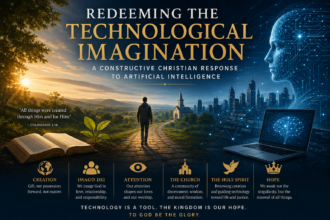
The article concludes by proposing a “pneumatological ethic” for digital ministry rooted in five principles:
- Instrumental humility — AI may assist ministry but cannot mediate salvation.
- Attentional formation — technology must deepen attentiveness to God and neighbour.
- Communal discernment — tools must remain accountable to the Church.
- Transparency and truthfulness — believers should know how AI is being used.
- Preferential human presence — human relationships must remain primary.
The central argument remains clear:
The Holy Spirit, not technology, is the true agent of ministry.
Conclusion
The rise of values-aligned AI presents both opportunity and temptation for the Church.
AI may offer extraordinary efficiencies and useful ministry support.
But it also risks replacing spiritual discernment with technological optimisation.
Ultimately, the question is not whether AI can articulate Christian values.
The deeper question is whether its use draws believers more deeply into:
- communion,
- attentiveness,
- discipleship,
- and the living presence of God.
As digital culture increasingly mediates human experience, the Church is called to bear witness to another form of mediation:
the incarnational and pneumatic presence of Christ among His people.
AI may assist the administration of ministry.
But transformation remains the work of the Holy Spirit alone.
Author Box
Brendon Naicker is a theologian, author, and teacher whose work explores theology, artificial intelligence, digital culture, discipleship, and spiritual formation. His research focuses particularly on AI ethics, theological anthropology, pneumatology, and the future of Christian ministry in a technological age.