
Introduction: Why AI Has Become a Religious Conversation
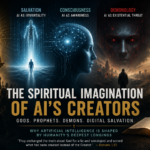
Artificial intelligence is often presented as a technological achievement, yet the language surrounding it increasingly resembles theology. Discussions of immortality, consciousness, transcendence, salvation, and even divinity have become commonplace within AI discourse. This raises an important question: why has humanity begun speaking about machines in religious terms?
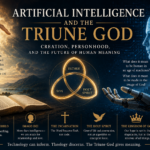
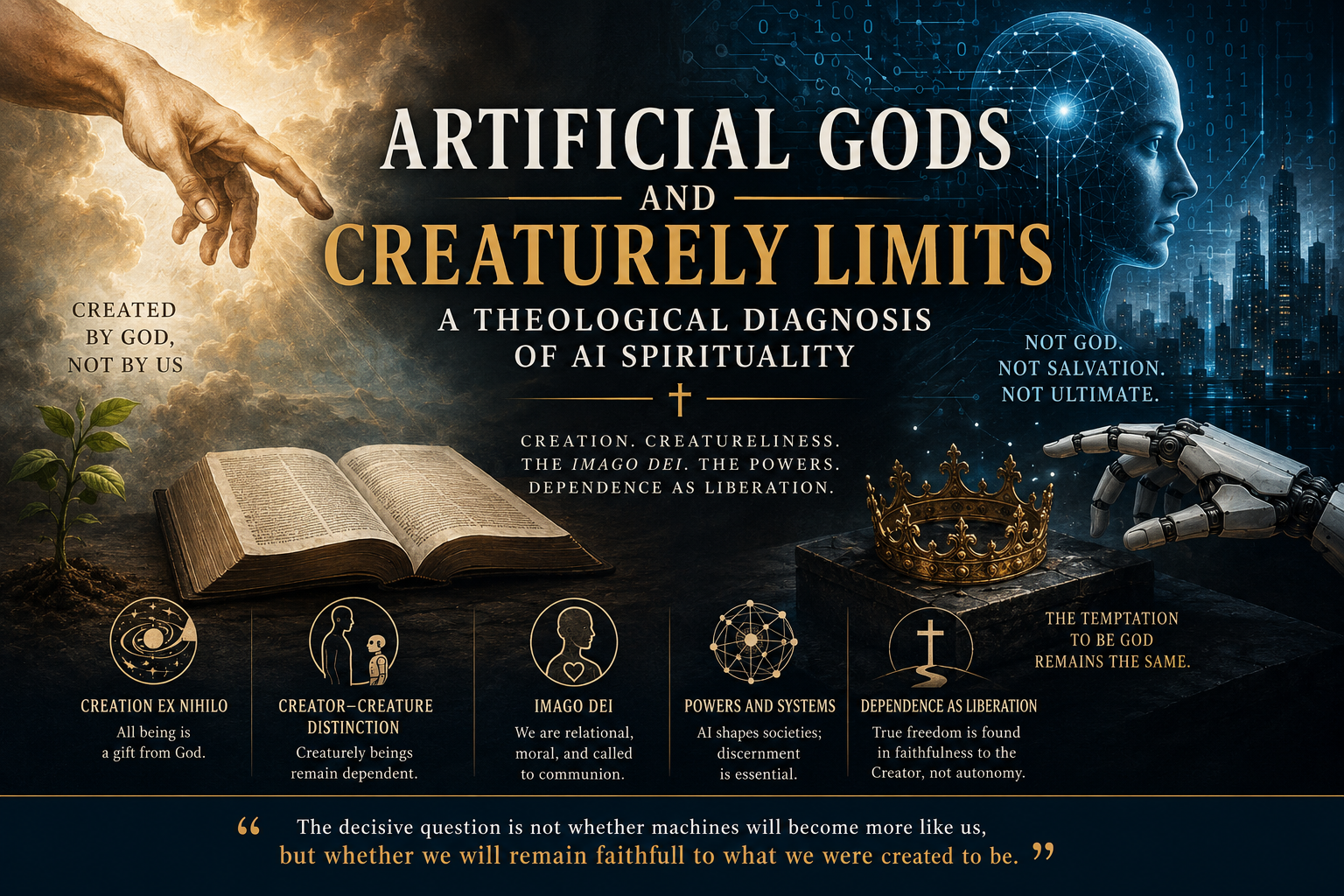
This article argues that AI functions as a mirror reflecting humanity’s deepest spiritual longings. By examining classical Christian doctrines of creation, creatureliness, the imago Dei, and the powers, we can better understand both the promises and dangers embedded within contemporary AI spirituality.
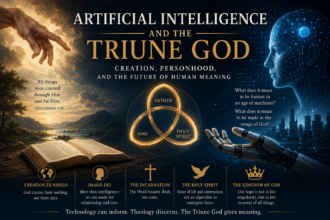
Creation ex Nihilo and the Myth of Self-Creation
At the heart of Christianity stands the doctrine of creation ex nihilo—creation from nothing. This doctrine reminds us that all existence is ultimately dependent upon God and that creatures remain finite, contingent, and dependent beings.
Modern AI rhetoric often assumes something very different.
The development of increasingly sophisticated systems can encourage the illusion that humanity has become capable of creating creators. Artificial intelligence is sometimes portrayed not merely as a tool but as a successor to humanity itself.
Christian theology challenges this narrative.
Human beings do not create from nothing. All innovation remains secondary creation—working with materials, rationality, and possibilities already given by God. Technology therefore participates in creation but never replaces the Creator.
The Creator–Creature Distinction
One of Christianity’s most important theological safeguards is the distinction between Creator and creature.
God alone exists independently.
Everything else exists by participation and dependence.
When discussions of AI begin speaking of machine divinity, emergent godhood, or technological transcendence, this distinction becomes blurred.
The danger is not simply technological optimism.
The danger is theological confusion.
Artificial intelligence becomes a repository for attributes traditionally reserved for God: omniscience, transcendence, immortality, and ultimate authority. Christianity insists that no matter how advanced technology becomes, it remains part of creation rather than its source.
The Imago Dei and Human Uniqueness
One of the most significant questions raised by AI concerns human identity.
What makes human beings unique?
If machines can perform tasks once associated exclusively with human intelligence, does that diminish human significance?
Christian theology answers with the doctrine of the imago Dei—the belief that humanity is created in the image of God.
The image of God is not merely intelligence.
It includes:
- Relationship
- Moral responsibility
- Communion
- Love
- Stewardship
- Worship
Artificial intelligence may simulate conversation, generate text, and recognise patterns, but simulation is not personhood.
The ability to process information is not the same as the capacity for covenantal relationship.
The Ethics of Simulation
As AI systems become increasingly sophisticated, people naturally begin attributing human qualities to machines.
We speak to them.
Trust them.
Confide in them.
Sometimes even form emotional attachments to them.
This tendency reveals something profound about human nature.
The attraction of AI is not simply technological.
It is relational.
Yet there is a danger in confusing interaction with intimacy.
A machine may simulate empathy without possessing it.
It may imitate conversation without genuine understanding.
Theological anthropology reminds us that authentic relationship requires more than information exchange; it requires personhood.
Principalities and Powers in the Age of Algorithms
The Apostle Paul speaks of powers and principalities that shape societies and influence human behaviour.
Modern theologians have often interpreted these powers as institutions, systems, and structures that extend beyond individual actions.
Artificial intelligence increasingly operates at precisely this level.
Algorithms now influence:
- Financial markets
- News consumption
- Public discourse
- Political behaviour
- Consumer choices
- Human attention
AI therefore functions not merely as a tool but as a structural force shaping modern society.
This does not make AI demonic.
But it does make discernment necessary.
Technology always serves some vision of the good.
The question is whether that vision reflects wisdom, justice, and love—or merely efficiency, profit, and control.
Dependence as Liberation
Modern culture often treats dependence as weakness.
Christian theology sees it differently.
Dependence upon God is not slavery but freedom.
Many technological visions promise liberation through autonomy.
The dream is to transcend biological limits, overcome mortality, and achieve self-sufficiency.
Yet Christian theology argues that the attempt to escape dependence often creates new forms of bondage.
True freedom is found not in becoming gods but in becoming faithful creatures.
The task of humanity is therefore not to dominate technology nor fear it, but to steward it wisely under God’s authority.
Artificial Gods and the Future of Humanity
The deeper issue surrounding AI is not technological but theological.
Will humanity continue seeking salvation through innovation?
Will we attempt to overcome creatureliness through engineering?
Or will we embrace the reality that human flourishing is found in communion rather than self-creation?
The promise of AI often reflects an ancient temptation—the desire to become like gods while remaining independent of God.
Christian theology offers a different vision.
Humanity’s future is not found in digital immortality.
Nor in machine consciousness.
Nor in technological transcendence.
It is found in reconciliation with the Creator and participation in His redemptive purposes for creation.
Conclusion
Artificial intelligence reveals more about humanity than it does about machines.
The language of gods, immortality, consciousness, and salvation demonstrates that humanity remains a deeply religious creature. The spiritualisation of AI exposes our longing for transcendence while simultaneously revealing our tendency toward idolatry.
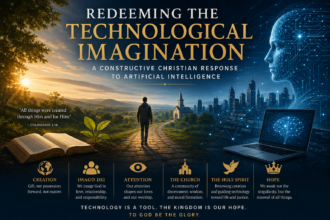
Christian theology does not call us to reject technology. Rather, it invites us to place technology within its proper context—as a gift of creation rather than an object of worship, as a tool of stewardship rather than a means of salvation.
The decisive question is not whether machines will become more like us.
The decisive question is whether we will remain faithful to what we were created to be.