






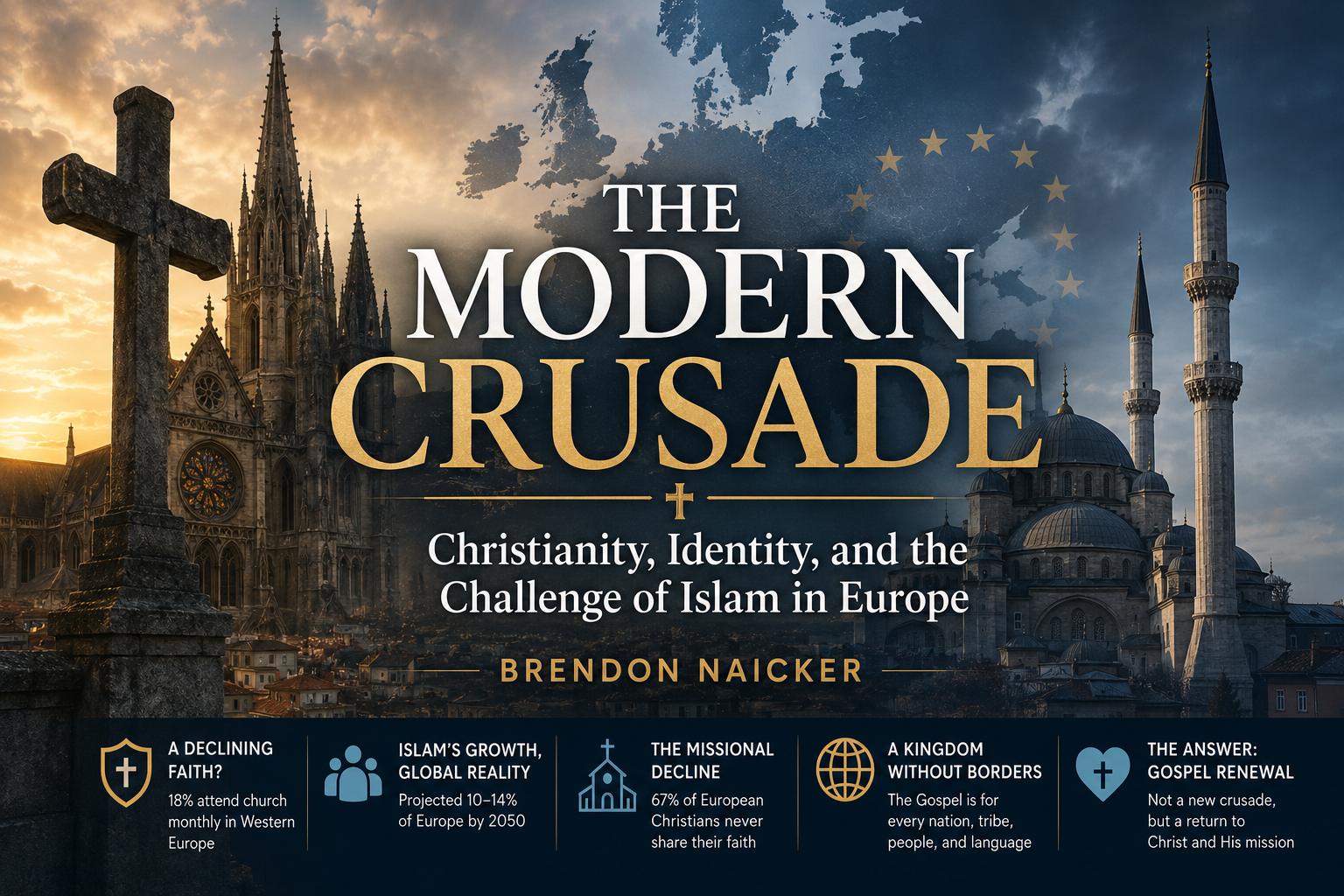
Christianity has shaped Europe’s cultural, political, and spiritual landscape for centuries. Yet in the twenty-first century, Christianity is increasingly presented not as a faith centred on salvation through Christ, but as a cultural marker used to defend European identity against perceived threats from Islam.
This article argues that such a shift mirrors earlier historical patterns in which Christianity became intertwined with political identity and civilisational defence rather than gospel proclamation.
The central claim is provocative:
The challenge facing Christianity in Europe is not primarily the growth of Islam.
It is the decline of Christianity itself.
From Living Faith to Cultural Identity
Throughout history, Christianity has often been used for political and national purposes.
The article highlights examples such as:
- the Crusades,
- the Thirty Years’ War,
- and various nationalist movements throughout European history.
In each case, Christianity became intertwined with:
- territory,
- ethnicity,
- political allegiance,
- and cultural identity.
Today, a similar pattern appears in parts of Europe where Christianity is increasingly invoked as a defence against Islam rather than proclaimed as a message of salvation through Jesus Christ.
The Decline of European Christianity
The article points to sobering demographic realities.
Across Western Europe:
- Only 18% of Western Europeans attend church monthly.
- In parts of Scandinavia attendance falls as low as 5%.
- More than a quarter of Europeans now identify as religiously unaffiliated.
The issue therefore extends beyond religious competition.
The article argues that Europe is experiencing a profound loss of Christian conviction, discipleship, and participation.
Islam’s Growth and Christian Anxiety
The paper acknowledges that Islam is currently the fastest-growing religion in Europe and may constitute between 10% and 14% of the European population by 2050.
This growth is driven primarily by:
- higher birth rates,
- conversion,
- migration,
- and active community-building.
The article notes that Muslim communities frequently demonstrate:
- strong family structures,
- intentional faith formation,
- community cohesion,
- and active outreach.
Yet the author argues that anxiety about Islam often obscures a more uncomfortable truth:
Christian decline is largely self-inflicted.
Christianity’s Missional Decline
One of the article’s strongest observations concerns the decline of evangelism within European Christianity.
The statistics cited are striking:
- Only 10% of young adults in the UK identify as Anglican.
- 67% of European Christians never share their faith with others.
The article argues that Christianity increasingly survives as:
- heritage,
- tradition,
- and cultural memory,
rather than as a living missionary faith.
Many defend Christianity as part of European identity while rarely participating in its mission.
A Global Kingdom, Not a Civilisational Bloc
Theologically, the article emphasises that Christianity has always been a transnational faith.
Scripture consistently presents the people of God as:
- multi-ethnic,
- multinational,
- and globally diverse.
Revelation 7:9 envisions worshippers from:
“every nation, tribe, people, and language.”
Likewise, Jesus commands His followers to:
“make disciples of all nations.”
The article therefore rejects the idea that Christianity should function primarily as a defence of European civilisation.
Christianity is not a cultural bloc.
It is a global kingdom centred on Christ.
Historical Lessons
The paper highlights a recurring historical pattern:
Christianity has often flourished most when it possessed little political power and focused intensely on mission.
The early Church grew rapidly despite persecution.
By contrast, state-supported Christianity frequently produced:
- nominal faith,
- institutionalism,
- and spiritual stagnation.
The lesson is clear:
The future of Christianity does not depend upon political dominance but upon faithful witness.
Toward a Gospel-Centred Response
Rather than responding to Islam through fear or cultural defensiveness, the article proposes a different path.
Revitalise Evangelism
European Christianity must rediscover the missionary zeal that characterises thriving Christian communities throughout Africa, Asia, and the Global South.
Reject Nationalist Christianity
Believers must resist conflating Christianity with ethnicity, nationalism, or cultural superiority.
The Gospel transcends national borders.
Embrace Demographic Change
The Church must recognise that God’s kingdom is larger than any single civilisation or continent.
The growth of Christianity in Africa, Asia, and Latin America demonstrates that Christianity’s future is increasingly global rather than exclusively Western.
Conclusion
The article concludes that Europe’s challenge is not ultimately Islam.
It is the erosion of Christian faith, discipleship, and mission.
When Christianity becomes merely a cultural identity, it loses its evangelistic power.
The answer is not a modern crusade.
It is a renewed commitment to:
- the Gospel,
- evangelism,
- discipleship,
- and the global kingdom of Christ.
The future of Christianity in Europe will not be secured through civilisational defence.
It will be secured through faithful witness to Jesus Christ.
Author
Brendon Naicker is a theologian, author, and teacher whose work explores theology, culture, Christian mission, and the challenges facing the contemporary Church. His writing frequently engages questions surrounding identity, evangelism, global Christianity, and the relationship between faith and society.