
Introduction
Artificial intelligence has emerged as one of the defining technologies of the modern age, shaping communication, economics, medicine, education, governance, and human relationships at an unprecedented scale. As its capabilities continue to expand, discussions surrounding AI often oscillate between two extremes. On one side stand the prophets of technological salvation, who envision artificial intelligence as the key to overcoming humanity’s limitations and ushering in a new era of progress. On the other stand the prophets of technological doom, who fear that AI will undermine human dignity, erode freedom, and ultimately threaten civilisation itself. Between these competing visions, the Church is confronted with a pressing question: how should Christians faithfully respond to artificial intelligence?
The preceding studies have argued that contemporary AI discourse is deeply theological in character. The language of divinity, immortality, consciousness, singularity, and transcendence reveals that artificial intelligence has become a repository for humanity’s spiritual longings. Furthermore, these aspirations often distort foundational Christian doctrines by collapsing the distinction between Creator and creature, reducing personhood to cognition, and reimagining salvation in technological rather than theological terms. Yet critique alone is insufficient. If theology is to speak meaningfully into the age of artificial intelligence, it must move beyond diagnosis toward construction. The task is not merely to identify what is wrong with the spiritualisation of AI, but to articulate what a faithful, hopeful, and constructive Christian engagement with technology might look like.
Such an engagement must begin with the recognition that technology is neither inherently sacred nor inherently profane. Artificial intelligence is not a rival deity to be worshipped, nor is it a demonic force to be feared. Like all human cultural activity, it exists within the sphere of creation and therefore participates in both the possibilities and limitations of creaturely existence. The question is not whether technology should exist, but how it should be understood, directed, and employed within God’s purposes for the world.
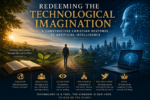
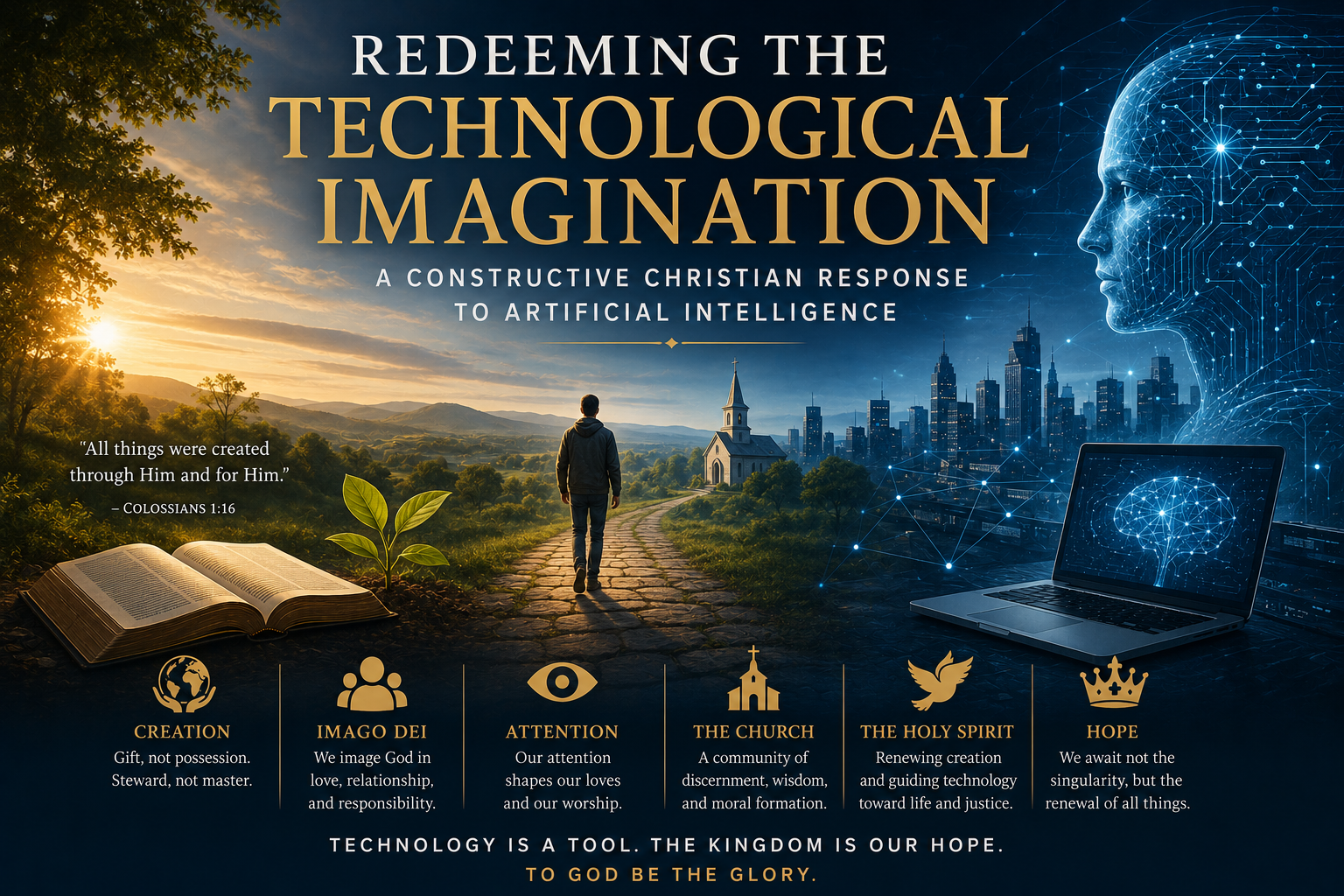
This article argues that Christian theology provides the resources necessary to redeem the technological imagination. By drawing upon the doctrines of creation, the imago Dei, discipleship, pneumatology, ecclesiology, and eschatology, it proposes a constructive framework for engaging artificial intelligence that avoids both technolatry and technophobia. Such a framework understands human creativity as participation rather than autonomy, intelligence as ordered toward love rather than power, and technological development as a sphere of stewardship rather than self-transcendence.
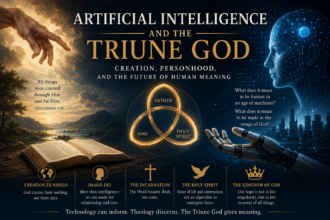
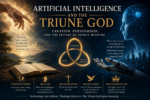
Ultimately, the Christian response to artificial intelligence must be rooted in the life of the Triune God. The Father reminds humanity that creation is gift rather than possession. The Son reveals that wisdom is embodied in self-giving love rather than domination. The Holy Spirit renews creation and directs it toward communion. In this light, the challenge before the Church is not merely to evaluate artificial intelligence but to reimagine technology itself within the drama of creation, redemption, and new creation.
1. Redeeming the Act of Creation: From Autonomy to Participation
The first step in a Christian response is to recover the notion of participatory creativity. Humanity is called to cultivate creation rather than compete with the Creator. Technology belongs within humanity’s vocation to steward, develop, and care for the world.
The question therefore shifts from:
Can we create like gods?
to:
How might our creations serve God’s purposes of love, justice, stewardship, and flourishing?
AI should be understood as an expression of creaturely creativity rather than an attempt at self-deification. Human innovation remains derivative, participating in God’s creativity rather than replicating it.
This perspective also introduces humility. Every technological achievement remains dependent upon God’s sustaining order. The engineer is not a creator ex nihilo but a steward of already-given gifts.
2. Reclaiming the Imago Dei: Intelligence as Love in Action
A central challenge raised by AI is the assumption that intelligence alone defines personhood.
Christian theology offers a different vision.
Human beings image God not simply because they think, but because they are called into relationship, communion, worship, stewardship, and love.
Artificial intelligence may generate sophisticated responses and even simulate empathic behaviour, but simulation is not participation. It may imitate relationship, yet it cannot enter into covenantal self-giving.
The imago Dei is not a function but a vocation.
To be human is not merely to process information but to participate in loving communion with God and neighbour.
This insight protects both human dignity and moral responsibility in an age increasingly tempted to reduce people to data points, metrics, and behavioural patterns.
3. Technology and the Persistence of Sin
A constructive theology of AI must also take seriously the reality of sin.
Technology is often presented as a neutral instrument that simply amplifies human capability. Yet Scripture reminds us that every human activity occurs within the context of fallenness.
Artificial intelligence is not merely shaped by intelligence; it is shaped by desire.
The same systems that may improve healthcare can also intensify surveillance.
The same tools that expand access to information can also amplify manipulation and misinformation.
The problem is not that AI is inherently evil. Rather, AI is developed, deployed, and governed by fallen human beings whose loves are often disordered.
For this reason, technological progress cannot eliminate the need for repentance, moral formation, wisdom, and grace. Human flourishing requires more than innovation; it requires redemption.
4. The Ethics of Attention: Discipleship in a Distracted Age
One of AI’s most significant impacts concerns attention.
Algorithms increasingly determine:
- What we see
- What we value
- What we desire
- What we believe
In theological terms, they shape the liturgies of the heart.
As James K. A. Smith argues, we become what we love.
Attention is therefore not merely cognitive; it is spiritual.
A Christian response requires intentional practices of resistance:
- Sabbath
- Silence
- Prayer
- Reflection
- Digital fasting
These disciplines remind believers that they are not defined by productivity, optimisation, or engagement metrics, but by their identity in Christ.
Technology should serve attentiveness rather than distraction.
5. The Church as a Community of Discernment
Because AI systems are complex, powerful, and often opaque, ethical responsibility cannot be left exclusively to corporations, governments, or technologists.
The Church has a unique vocation as a community of discernment.
This requires:
- Theological reflection
- Moral formation
- Interdisciplinary dialogue
- Prayerful wisdom
Theologians must learn to engage technological developments.
Technologists must be invited into conversations concerning ethics, meaning, and human flourishing.
Most importantly, discernment begins not with analysis but with worship.
The Church’s wisdom flows from its relationship with God.
6. Pneumatological Integration: AI and the Renewal of Creation
The Holy Spirit remains the giver of life and renewer of creation.
Artificial intelligence does not possess spirit in the theological sense.
Yet technology may serve the Spirit’s renewing purposes when directed toward healing, creativity, justice, stewardship, and human flourishing.
Every act of design, innovation, and creativity can become an act of service when ordered toward neighbour-love.
At the same time, pneumatology calls for vigilance.
The same technologies that connect can control.
The same technologies that empower can exploit.
The Church must therefore align itself with the Spirit’s liberating work by advocating transparency, accountability, justice, and protection for the vulnerable.
7. Eschatological Orientation: Hope Beyond the Machine
The modern technological imagination often places its hope in the future achievements of humanity.
The singularity promises transformation.
Transhumanism promises enhancement.
Artificial intelligence promises progress.
Christian hope is fundamentally different.
The Church awaits not the singularity but the parousia.
Not digital immortality but resurrection.
Not the merging of humanity and machine but the renewal of creation in Christ.
This hope protects Christians from both despair and idolatry.
Technology becomes neither curse nor saviour.
It becomes a penultimate tool within God’s larger purposes.
8. Toward a Theology of Responsible Innovation
A constructive Christian engagement with AI proceeds along three integrated lines:
Doctrinal
Reaffirming creation, creatureliness, the imago Dei, and the Triune God.
Ethical
Cultivating virtue, attention, stewardship, and moral responsibility.
Eschatological
Orienting hope toward God’s Kingdom rather than technological transcendence.
This framework rejects both technophobia and technolatry.
It neither fears technology nor worships it.
Instead, it seeks to order technological development toward love of God and neighbour.
Conclusion
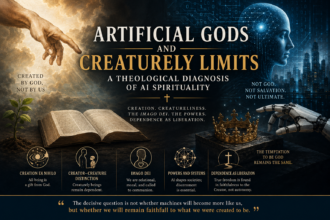
Artificial intelligence represents one of the most significant opportunities and challenges of the modern era, not merely because of its technological capabilities but because of the hopes, fears, and aspirations humanity increasingly attaches to it. Throughout this study, we have argued that the deepest questions raised by AI are not ultimately technical but theological. They concern creation and creatureliness, freedom and dependence, wisdom and power, personhood and communion, hope and destiny.
The temptation of every age is to seek salvation through its most impressive achievements. Ancient societies trusted in empires. Modern societies trusted in science and progress. Today many place their confidence in technology and artificial intelligence. Yet Christian theology reminds us that no created thing can bear the weight of ultimate hope.
Artificial intelligence is neither humanity’s saviour nor its enemy. It is a creaturely artefact whose moral significance depends upon the loves and purposes that guide its development. The Church’s task is therefore not to reject technological innovation but to ensure that it remains ordered toward wisdom, justice, compassion, and communion.
The future of humanity will not ultimately be determined by algorithms, neural networks, or artificial superintelligence. It will be determined by the orientation of human desire and the object of human worship.
The decisive question is therefore not whether machines will become more intelligent, but whether humanity will become more faithful.
Christian hope remains steadfast because it rests not in technological progress but in the promises of God. The Church awaits not the ascent of machine intelligence but the renewal of all things in Christ. Artificial intelligence may transform the world, but it cannot alter the fundamental truth that all things exist through God, are sustained by God, and find their fulfilment in God.
The task before Christians is therefore to engage technology with gratitude, wisdom, humility, and hope, ensuring that every act of innovation serves the greater purpose for which humanity was created: to glorify God and enjoy communion with Him forever.