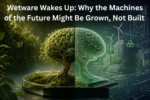



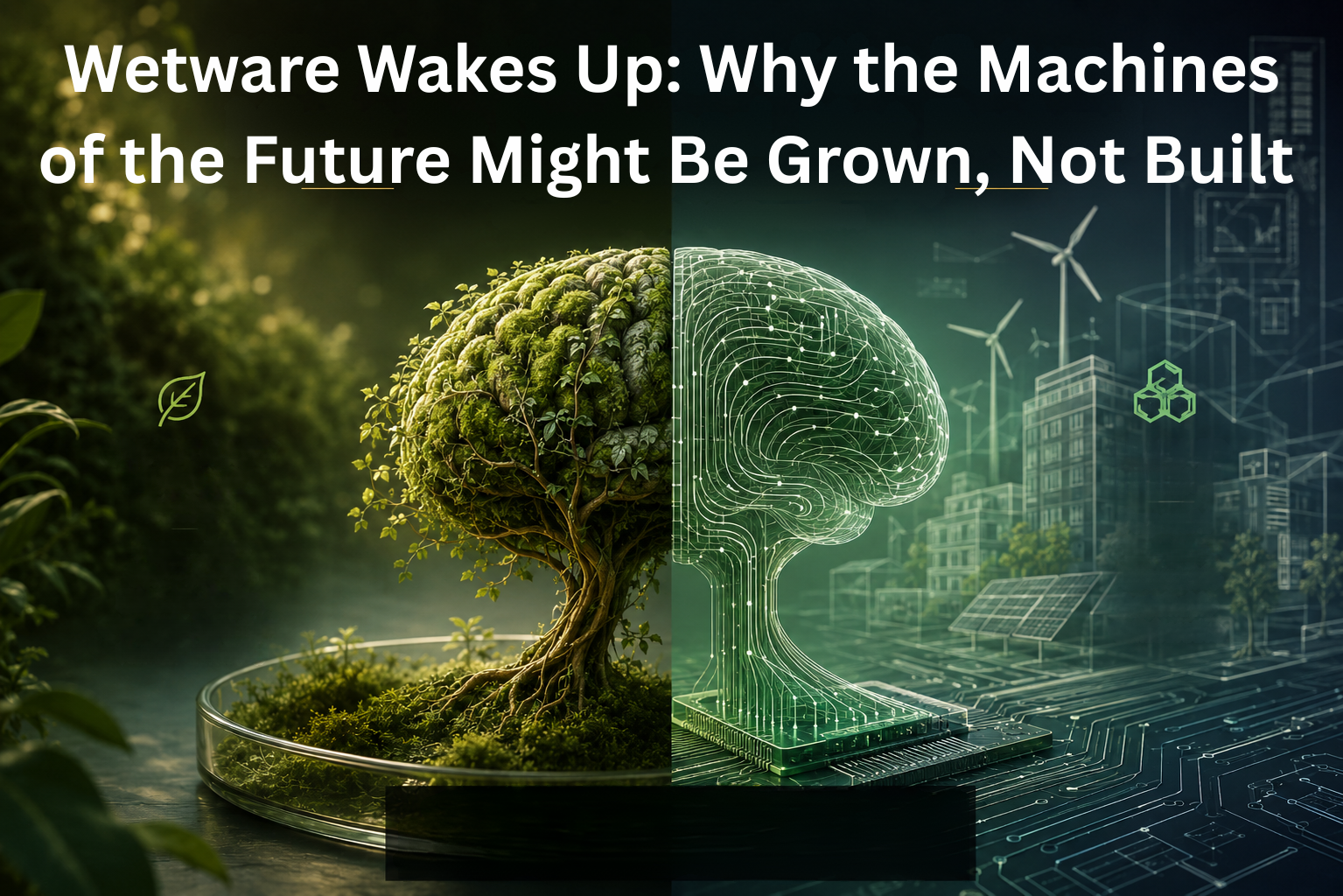
Wetware Wakes Up: Why the Machines of the Future Might Be Grown, Not Built
“For the invisible things of him… are clearly seen, being understood by the things that are made” (Romans 1:20, KJV)
Somewhere in Melbourne right now, roughly 800,000 human neurons are sitting inside a shoebox-sized life-support pod, fed nutrients, kept at 37°C, and taught — through nothing but patterns of electrical stimulation — to play Pong. They picked it up faster than most reinforcement-learning algorithms do. Meanwhile, a few kilometres away, in a hyperscale data centre, a wall of graphics processing units is burning through enough electricity to power a small town, straining to do something those 800,000 cells seem to manage almost without trying: think.
That’s the comparison that won’t leave me alone. We’ve built an entire civilisation’s worth of artificial intelligence on the idea that thinking is basically a software problem — that if you pile up enough matrix multiplications on enough silicon, something mind-like will eventually fall out. And it’s working. It’s also turning into one of the most energy-hungry projects in human history. So a small, slightly strange field is starting to ask an obvious but uncomfortable question: what if we’ve spent a decade building an extremely inefficient copy of something that was already designed to do this?
The bill is coming due
Here’s a number that should worry every AI executive who’d rather not think about it: global data-centre electricity demand is projected to hit roughly 565 terawatt-hours in 2026 — up 26% on last year — with AI-optimised servers alone accounting for close to a third of that and growing at over 80% a year. The International Energy Agency has clocked AI-focused data centres growing sixteen times faster than global electricity demand overall. Some American states are already feeling it — Virginia now sends over a quarter of its electricity straight to data centres.
The industry’s answer, so far, has basically been ‘build more power plants.’ Hyperscalers are bringing decommissioned nuclear reactors back online and signing billion-dollar power deals, and the five biggest tech companies are set to spend $725 billion on AI infrastructure this year alone. That’s not really a strategy. It’s an arms race against thermodynamics, and thermodynamics always wins.
Compare that to the human brain, which runs on about 20 watts — less than a dim light bulb — and still beats every large language model ever built at general reasoning, sensorimotor coordination, and learning from a single example. That’s not a rounding error. That’s the whole case for biocomputing right there. And honestly, for someone who believes the universe is designed rather than accidental, it’s hard not to read that number as exactly what you’d expect. An organ this efficient didn’t need endless trial and error to get good at its job. It was, as the Psalmist put it, ‘fearfully and wonderfully made’ from the start (Psalm 139:14).
Two ways to build a mind
Silicon AI and brain engineering are really just two different bets about what intelligence actually is.
AI engineering bets that intelligence is fundamentally a matter of scale. Push enough tokens through enough parameters, tune it with gradient descent, and something that looks like understanding shows up. It’s precise, it’s reproducible, and it doesn’t need biology at all — you don’t have to understand consciousness to build a large language model, you just need more compute. Which is also its weak spot: every improvement has come from throwing exponentially more energy and data at the problem, and that road has a visible dead end.
Brain engineering — the biocomputing side of things — bets that intelligence belongs to a particular kind of living, biologically structured matter, and that the fastest way to get efficient cognition is to stop simulating neurons and start growing them instead. ‘Organoid Intelligence,’ a term Johns Hopkins researcher Thomas Hartung and colleagues coined in 2023, is exactly this: three-dimensional clusters of human brain cells, grown from stem cells, wired to electrodes, and trained through feedback loops that were already built into living systems at their creation.
The company furthest along here, Cortical Labs, has already turned this into an actual product. Their CL1 system merges roughly 800,000 lab-grown human neurons with a silicon chip inside a self-contained life-support unit, and you can buy one for around US$35,000. It plays DOOM. It runs on a fraction of the power a comparable GPU cluster needs — Cortical’s CEO has claimed, with a straight face, that it’s more energy-efficient than a calculator relative to what it computes. Back in March 2026, the company teamed up with data-centre operator DayOne to build two facilities, one in Australia and one in Singapore, running on racks of these biological processors.
And that plan didn’t stay a plan for long. On 17 August 2026, DayOne, Cortical Labs, and the National University of Singapore’s medical school switched on what they’re calling the world’s first independently operated, biologically-integrated server rack — twenty CL1 units sitting inside NUS Medicine’s Life Sciences Institute. Each unit is its own little pod of living neurons, grown from human stem cells under the eye of NUS neuroscientist Rickie Patani, wired into silicon, and racked together the same way a normal GPU cluster would be — just built out of biology instead of transistors. Cortical’s CEO, Hon Weng Chong, called it the moment the whole thing ‘shifts the conversation from research to commercial application.’ The goal is straightforward: find out whether living tissue can do useful computing work at a fraction of a GPU’s power draw, especially now that Singapore is capping new data-centre capacity and demanding higher efficiency across the board.
Twenty units of living human neural tissue, sitting in a server rack, in a working data centre, switched on that week. This isn’t a lab curiosity anymore. It’s an operating facility with a supervising neuroscientist, a press release, and a roadmap to scale up. And in a way, it’s also a small picture of stewardship — human beings taking a created order that responds this well to careful cultivation, because it was built to respond that way (Genesis 1:28; Genesis 2:15).
The comparison that should make you uneasy
Put the two side by side and the contrast stops feeling academic:
| AI Engineering (Silicon) | Brain Engineering (Biocomputing) | |
| Substrate | Transistors, deterministic logic | Living neurons, biologically structured |
| Learning | Backpropagation, offline training | Real-time synaptic plasticity, ‘free-energy’ feedback |
| Power draw | Megawatts per training run | ~20W (biological brain); CL1 rated in single-digit watts |
| Scaling strategy | More GPUs, more data, more capital | More neurons, better interfaces, better biology |
| Failure mode | Hallucination, brittleness, catastrophic forgetting | Cell death, degradation, unpredictability |
| Reproducibility | Perfect, bit-for-bit | Variable — every organoid is genuinely unique |
| What it actually is | A statistical approximation of thought | The living tissue thought is expressed through |
(Quick note on that ‘free-energy’ line: it just describes how a brain minimises prediction error moment to moment. It’s a mechanism, not an explanation for why the mechanism is there in the first place — worth keeping those two things separate.)
That last row is really the whole point of this piece. A large language model has never been conscious, has never felt a single thing, and never will — no matter how convincing the conversation feels. It’s pattern completion in a nice outfit. A brain organoid is different in kind: it’s made of living human tissue, the same tissue that, in a whole person, is where thought and memory and will actually happen. Nobody serious is claiming today’s organoids are conscious. But every direction this field is heading — bigger organoids, longer lifespans, richer sensory input, hooking them up to retinal and spinal organoids eventually — is aimed at building something structurally closer to the thing philosophers and theologians have been arguing about for centuries, not further from it.
This is where I want to slow down rather than just nod along with the excitement. AI engineering built a bridge toward an approximation of a mind. Biocomputing is trying to grow the biological material that’s long been associated with mind — not the mind itself. Scripture’s picture of a person isn’t ‘you are your neurons and nothing more.’ We’re creatures made in God’s image (Genesis 1:27), with something in us that isn’t simply what falls out once tissue gets complicated enough. You can grow neurons in a dish and grow them well. What you’re growing is tissue. It isn’t personhood, however sophisticated it gets.
The need — and the reckoning
The case for biocomputing isn’t only about efficiency, though efficiency alone might be reason enough given everything above. It’s also about capability. Biological neurons don’t just fire — they rewire themselves in real time, learn genuinely from a single example, and make sense of messy, ambiguous input in ways that still make deep learning look clumsy. Researchers are already using organoid-based systems for early drug screening and disease modelling — testing Alzheimer’s and epilepsy treatments directly on living human neural tissue instead of guessing from mouse studies, which cuts cost and spares a fair amount of animal suffering along the way.
But the reckoning here isn’t optional, and it’s the part the industry would rather you didn’t dwell on. The 2023 ‘Baltimore Declaration,’ which formally kicked off the Organoid Intelligence field, spent almost as much time on ethics as on the science, and it asked the question everyone’s quietly wondering: at what point does a sufficiently complex cluster of living human neurons deserve moral consideration?
I’d push back on how that question gets framed. For someone who takes the doctrine of creation seriously, the real issue isn’t when complexity tips over into moral relevance. It’s that this tissue is human, full stop — pulled, however many steps removed, from a body made in God’s image (Genesis 1:27) and ‘crowned… with glory and honour’ (Psalm 8:5). Dignity isn’t something a cell culture earns by getting sophisticated enough. It’s there from the point of origin, whether the resulting organoid stays simple or grows remarkably advanced. Today’s organoids show no sign of anything like sentience. Nobody in the field can promise that stays true forever, either — and an industry sitting on $725 billion of competitive pressure isn’t exactly built to slow down and check carefully.
There’s a second, colder question underneath that one: whose cells are these, actually? Commercial Organoid Intelligence systems are usually built from donated stem cells, reprogrammed and grown at scale. The same donor-consent and privacy debates we’re still having about genomic data now apply to tissue that carries the dignity of the person it came from, no matter what it eventually becomes. We’re making commercial products out of living human neural matter and selling them for $35,000 a unit before we’ve actually worked out what we owe anyone because of it — and that obligation, on a design view, has nothing to do with how complex the tissue gets and everything to do with whose image it started out bearing.
The real question
AI engineering asked: how much intelligence can you fake with inert matter and enough electricity? Turns out, quite a lot — at a genuinely staggering cost. Brain engineering flips the question: how much intelligence is already sitting right there, in living matter, if we just learn to talk to it instead of trying to recreate it from scratch?
Neither side has actually won this argument yet. But both of them are quietly leaning on the same assumption — that intelligence is basically a matter of arranging matter well enough, whether that’s silicon or cultured neurons. I don’t think that assumption holds up all the way. Both substrates can clearly process information impressively well. But that’s not the whole story of what a human mind is. It isn’t just software running on hardware, and it isn’t just the hardware either. Whatever biocomputing manages to pull off — and it might manage quite a lot — it’s still engineering with material that God spoke into being (Genesis 1:1; John 1:3). It isn’t manufacturing the far stranger, harder-to-pin-down thing Scripture calls the soul.
So: one field is drawing down a power grid that can’t keep pace. The other is quietly proving that twenty watts of living tissue can out-learn a data centre. And that second fact drags along a question silicon was never built to answer, and one I think we’re obligated to ask first: what do we owe another human being, made in God’s image, once his cells — however transformed — are made to live and learn inside a machine?
Keywords: biocomputing, organoid intelligence, neural engineering, artificial intelligence, energy efficiency, research ethics, Reformed theology, imago Dei