Introduction
The relationship between mental illness and demonic possession has been debated throughout history across both religious and medical contexts.
In the ancient world, many forms of suffering and abnormal behaviour were commonly interpreted through spiritual frameworks. In contrast, modern psychiatry and neuroscience largely explain mental illness through biological, psychological, and environmental causes.
This tension raises important questions for Christians today:
- Were some biblical possession accounts descriptions of mental illness?
- Should suffering be approached medically, spiritually, or both?
- How should the Church respond compassionately and responsibly?
This article explores these questions while emphasising the importance of holistic care and discernment.
Biblical Accounts: Possession or Illness?
The Gerasene Demoniac
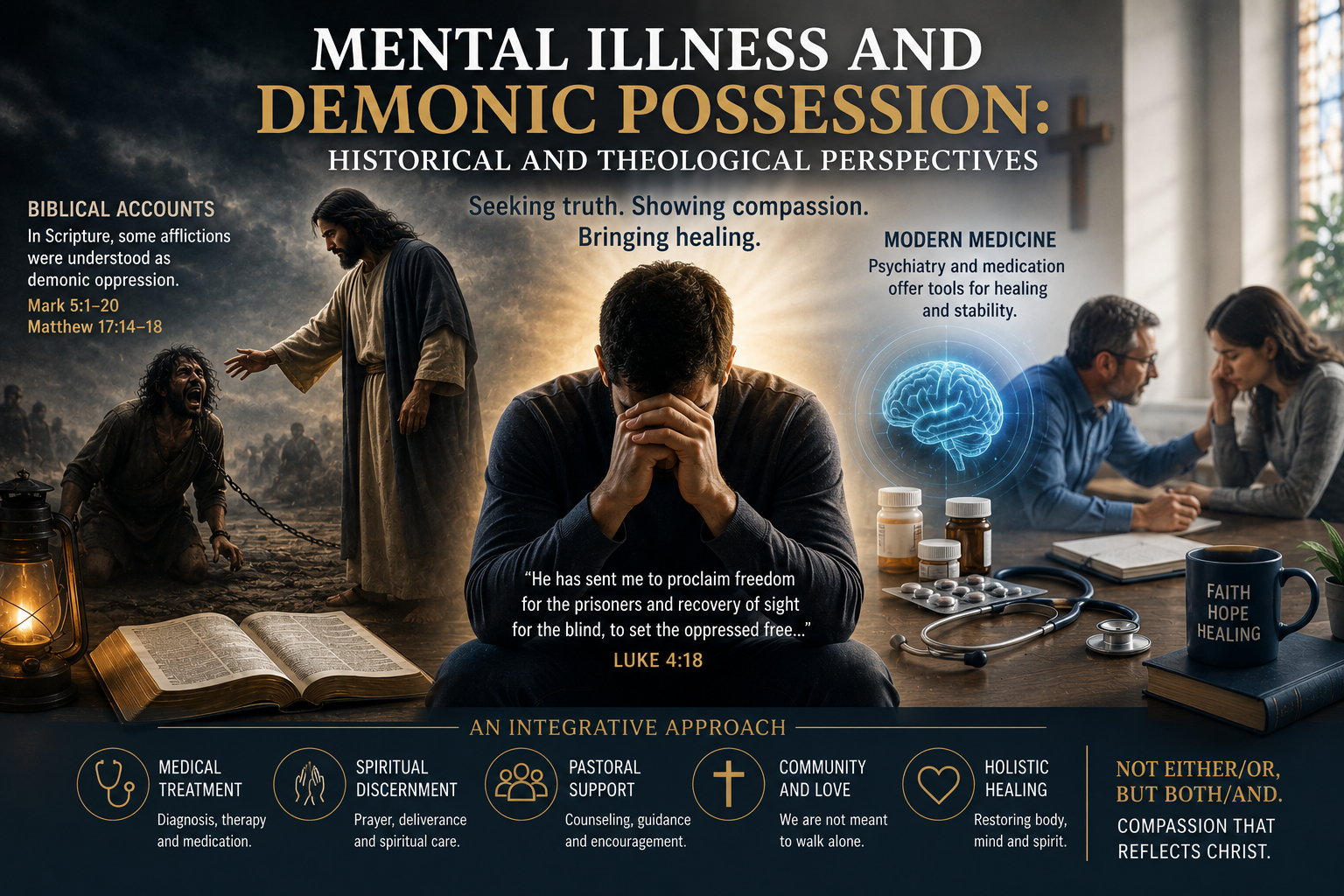
One of the most well-known biblical accounts is found in Mark 5:1–20.
The man described in the passage displayed behaviours such as:
- Isolation
- Violence
- Self-harm
- Emotional instability
Many modern readers observe similarities between these behaviours and severe psychiatric disorders or trauma-related conditions.
Yet within the biblical narrative, the condition is clearly presented through a spiritual framework involving demonic oppression.
This highlights the challenge of interpreting ancient accounts through modern categories alone.
The Epileptic Boy
In Matthew 17:14–18, a boy suffering from seizures and self-destructive episodes is brought to Jesus.
While modern medicine may identify epilepsy or neurological disorder, the Gospel account presents the condition as involving demonic activity.
These passages demonstrate that biblical writers often viewed physical, mental, and spiritual suffering as interconnected realities rather than isolated categories.
Jesus’ Holistic Healing Ministry
Jesus’ ministry consistently approached human suffering holistically.
His healings addressed:
- Physical restoration
- Spiritual reconciliation
- Emotional healing
- Social reintegration
In Luke 4:18, Jesus declares His mission to “set the oppressed free,” revealing a ministry concerned with total restoration rather than symptom management alone.
For Jesus, healing involved restoring individuals fully — body, mind, relationships, and spirit.
Modern Psychiatry and Medical Treatment
Modern medicine has transformed the treatment of mental illness.
Psychology, psychiatry, neuroscience, and medication have enabled many individuals suffering from severe conditions to live stable and functional lives.
Treatments such as:
- Antidepressants
- Antipsychotics
- Mood stabilisers
- Therapy and counselling
have provided enormous benefit to millions.
At the same time, the article raises important ethical and philosophical questions surrounding modern healthcare systems, particularly regarding the pharmaceutical industry’s emphasis on symptom management and long-term dependency.
Spiritual Deliverance and Discernment
Some theologians and Christian practitioners argue that certain forms of suffering may include spiritual dimensions that medicine alone cannot fully address.
M. Scott Peck, both psychiatrist and Christian thinker, suggested that some manifestations of human suffering involve profound spiritual realities requiring discernment alongside medical care.
However, the article cautions against simplistic conclusions.
Relying solely upon spiritual explanations may risk ignoring legitimate medical conditions, while relying exclusively on medical approaches may neglect deeper emotional, existential, or spiritual suffering.
Bridging Medical and Spiritual Care
The article ultimately proposes an integrative model of care.
Rather than placing medicine and spiritual care in opposition, the Church can recognise that human beings are complex persons consisting of:
- Mind
- Body
- Emotions
- Relationships
- Spirit
An integrative approach may therefore include:
- Professional medical treatment
- Counselling and therapy
- Pastoral support
- Prayer and spiritual care
- Community and discipleship
This model better reflects the holistic nature of Jesus’ ministry.
The Shift from Natural to Synthetic Healing
The article also reflects on how historical medicine often utilised natural remedies and holistic care practices, whereas much of modern treatment relies heavily on synthetic pharmaceuticals and compartmentalised healthcare systems.
While modern medicine has produced life-changing advancements, the article argues that healthcare should continue pursuing holistic restoration rather than purely symptom suppression.
Conclusion
The New Testament accounts of demonic possession reveal the complexity of human suffering, where spiritual, physical, emotional, and mental dimensions often overlap.
Modern medicine provides invaluable tools for treatment and care, yet Jesus’ healing ministry reminds believers that true restoration involves the whole person.
Rather than promoting fear, stigma, or simplistic explanations, Christians are called to respond with wisdom, compassion, discernment, and humility — recognising both the value of scientific advancement and the importance of spiritual care.