




Introduction
War remains one of humanity’s most troubling realities.
For Christians, conflict raises difficult questions. How do believers reconcile Christ’s command to love enemies with the responsibility to protect the innocent? Can warfare ever be morally justified? What should Christians do when war appears inevitable?
Throughout church history, Christians have answered these questions in different ways, resulting in two major traditions: Christian pacifism and Just War Theory. This article explores both approaches and considers how believers should respond in times of conflict.
Biblical Foundations
The Old Testament and Warfare
The Old Testament presents a complex picture of war.
At times, God is portrayed as acting in judgment against nations and intervening in military conflicts. The conquest narratives and Israel’s military history demonstrate God’s sovereignty over nations and history.
Yet the Old Testament also contains a powerful vision of peace.
The prophet Isaiah famously foretold a future where:
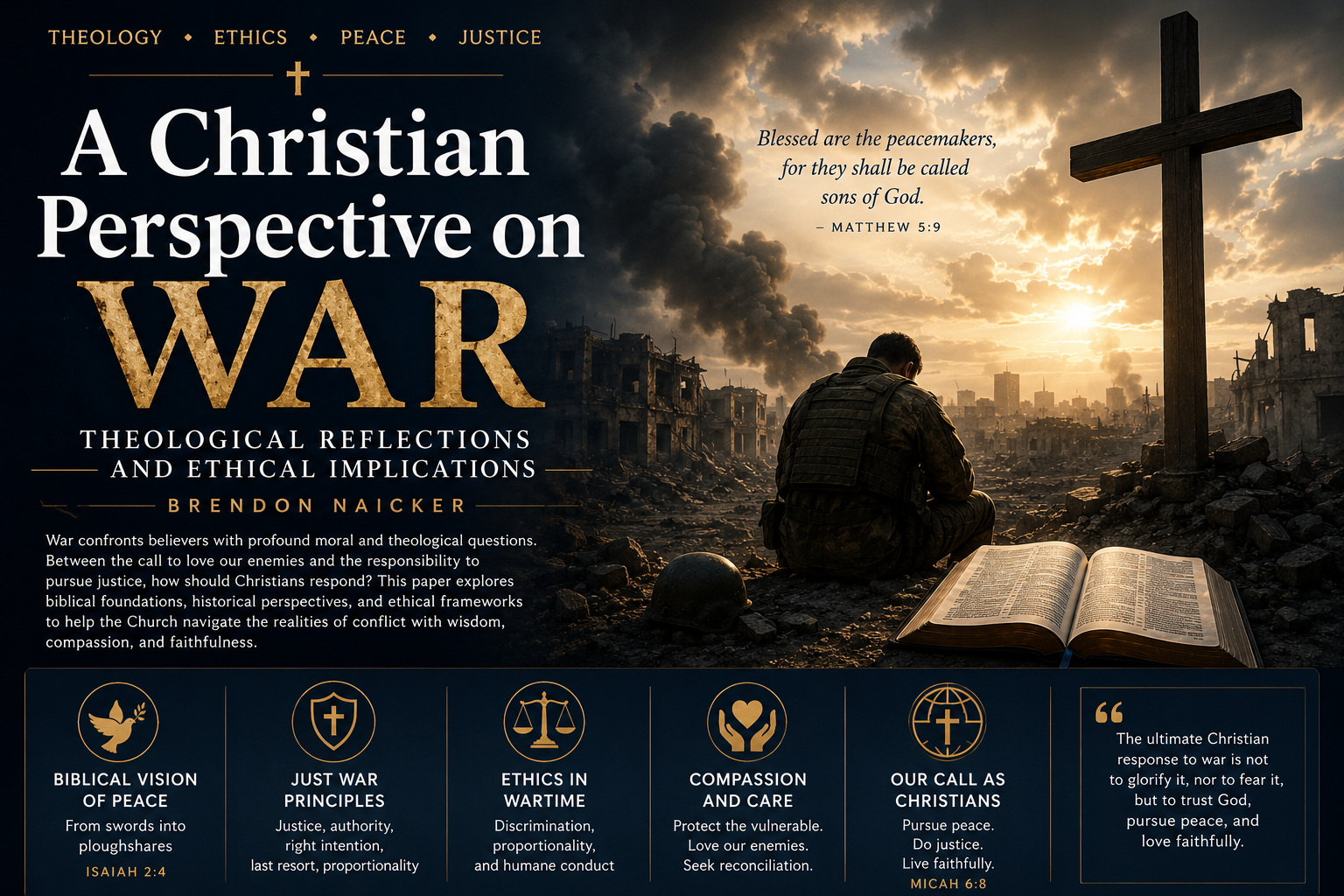
“They shall beat their swords into ploughshares.”
This prophetic vision points toward God’s ultimate purpose of reconciliation and peace among nations.
The New Testament and Nonviolence
The ministry of Jesus shifts attention toward forgiveness, reconciliation, and enemy love.
In the Sermon on the Mount, Jesus teaches:
“Love your enemies and pray for those who persecute you.”
His teachings challenge cycles of retaliation and call believers to embody a radically different kingdom ethic.
The Apostle Paul similarly urges believers to:
“Overcome evil with good.”
At the same time, Paul acknowledges the state’s authority to maintain justice and social order, creating an important tension within Christian ethics.
Christian Pacifism
The Early Church
For much of the early church period, Christians adopted strongly pacifist positions.
Early Christian writers such as Tertullian and Origen frequently viewed military service as incompatible with discipleship. Christians understood themselves as citizens of a heavenly kingdom whose primary battle was spiritual rather than military.
Pacifists argue that Jesus’ example demonstrates that Christians should reject violence and instead respond through:
- Prayer
- Forgiveness
- Nonviolent resistance
- Reconciliation
- Peacemaking
The Development of Just War Theory
The conversion of Constantine and the increasing integration of Christianity into public life created new ethical challenges.
As Christians assumed roles within government and military structures, theologians sought a framework that balanced peace with justice.
Augustine’s Contribution
Augustine argued that while war is always tragic, it may sometimes be morally necessary to protect the innocent and restrain evil.
Thomas Aquinas
Aquinas later developed a systematic framework for evaluating whether warfare could be morally justified.
His work became known as Just War Theory and continues to influence ethical discussions today.
Just War Principles
Jus ad Bellum (Justice Before War)
Before entering conflict, several criteria must be satisfied:
Just Cause
War must respond to genuine aggression or serious injustice.
Legitimate Authority
Only lawful governments possess authority to declare war.
Right Intention
The goal must be peace and justice rather than revenge or conquest.
Last Resort
All peaceful alternatives should first be exhausted.
Probability of Success
Military action should not be pursued when it will only increase suffering without achieving its objectives.
Jus in Bello (Justice During War)
Even when war is justified, moral limits remain.
Discrimination
Combatants must distinguish between military targets and civilians.
Proportionality
Military action should avoid excessive harm beyond what is necessary to achieve legitimate objectives.
How Should Christians Respond When War Is Imminent?
1. Seek God Through Prayer
Christians should begin with prayer, seeking wisdom, discernment, and guidance from Scripture. Faithfulness often requires navigating difficult moral complexities rather than simplistic answers.
2. Advocate for Peace
Believers should support diplomacy, reconciliation, and peaceful solutions wherever possible. The Church serves as a prophetic witness reminding societies that violence is never the ideal solution.
3. Protect the Vulnerable
War disproportionately affects civilians, refugees, children, and the poor.
Christians should actively support humanitarian efforts, aid organisations, and practical assistance for those displaced by conflict.
4. Exercise Ethical Discernment
Christians serving within military, government, or policy-making roles must carefully evaluate actions according to biblical principles of justice, mercy, and restraint.
5. Prepare for Reconciliation
Even during conflict, believers should look toward the work of post-war healing, forgiveness, and rebuilding relationships.
Contemporary Challenges
Modern warfare presents new ethical difficulties.
Nuclear weapons, drones, cyber warfare, and advanced military technologies blur traditional distinctions between combatants and civilians. These developments challenge Christians to think carefully about whether classical Just War principles can adequately address contemporary realities.
At the same time, churches continue to play an important role as communities of peace, reconciliation, and moral reflection within increasingly polarised societies.
Conclusion
Christian responses to war have historically ranged from absolute pacifism to carefully qualified support for Just War Theory.
Both traditions emerge from sincere attempts to apply biblical teaching to a fallen world marked by violence and injustice. Ultimately, Christians are called to pursue peace wherever possible, defend the vulnerable when necessary, and remain faithful to Christ’s kingdom in the midst of conflict.
The Church’s greatest witness is not found in military strength but in demonstrating the reconciling power of the Gospel in a world longing for peace.